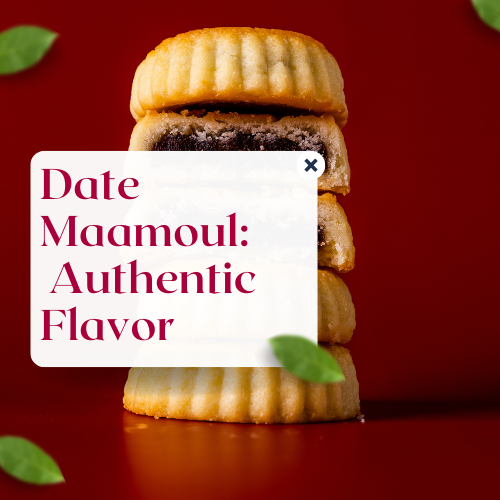
Date maamoul is one of the most famous traditional sweets in the Levant and the wider Middle East. It is known for its delicate, decorated pastry, soft date filling, and fragrant aroma, which often comes from rose water, orange blossom water, and traditional spices.
Date maamoul is not viewed simply as a dessert. It is strongly associated with hospitality, religious celebrations, and family gatherings. In many homes, preparations begin several days before the holidays, when family members gather to prepare the dough, make the filling, and shape each piece using traditional decorative molds.
What Is the Origin of Date Maamoul?
It is difficult to identify one country as the sole birthplace of maamoul in its modern form, as several regional cuisines have long traditions of making sweets filled with dates. However, maamoul as it is known today is especially associated with Levantine cuisine and is widely prepared in Lebanon, Syria, Palestine, and Jordan before spreading throughout the Arab world.
Some food historians connect maamoul to ancient traditions of date-filled pastries from Mesopotamia. Others point to similarities with Egyptian kahk and Iraqi kleicha. These sweets developed different names, shapes, and ingredients over time, yet they continued to serve as festive foods prepared for holidays and special occasions.
For this reason, date maamoul is best understood as part of a shared regional culinary heritage rather than as an invention that can be attributed with certainty to one country.
Why Is It Called Maamoul?
The Arabic word maamoul comes from the verb amila, meaning “to make” or “to prepare.” The name may reflect the care, skill, and effort required to produce this traditional sweet, particularly because each piece is filled, shaped, and decorated by hand.
The Ingredients Behind Its Distinctive Flavor
Maamoul dough is usually prepared with fine or coarse semolina. In some recipes, semolina is combined with flour. Ghee or butter is added to create a delicate, crumbly texture, while rose water or orange blossom water gives the pastry its characteristic Middle Eastern fragrance.
The filling is made from pitted dates that are kneaded until they become soft and easy to shape. A small amount of ghee may be added, along with cinnamon or cardamom, depending on local traditions and personal preference.
Maamoul can also be filled with pistachios or walnuts, but the date-filled variety remains one of the most popular and widely enjoyed versions.
Traditional Molds and Decorative Patterns
One of the most distinctive features of date maamoul is its beautifully decorated surface. For generations, artisans and home cooks have used carved wooden molds featuring geometric, floral, and traditional patterns.
A filled piece of dough is placed inside the mold and gently pressed until it takes on the desired shape. These patterns are not always purely decorative. In some families and bakeries, different designs are used to identify different fillings. One design may indicate dates, while another may represent walnuts or pistachios.
This allows guests to recognize the filling simply by looking at the shape and pattern of the maamoul.
Date Maamoul During Holidays and Celebrations
Date maamoul is closely associated with Eid al-Fitr, when it is commonly served to guests with Arabic coffee or tea following the end of Ramadan. It is also prepared by many Arab Christian families during Easter and Christmas.
Its presence in different religious celebrations shows how food traditions can cross cultural and religious boundaries. Maamoul has become part of the shared social memory of the region.
Preparing it is often a family activity involving several generations. Children learn how to fill the dough, use the molds, and shape the pastries by watching their parents and grandparents.
What Makes Date Maamoul Special?
Date maamoul combines two contrasting yet complementary textures: a delicate, crumbly pastry and a soft filling with natural sweetness. Rose water, orange blossom water, cardamom, and other traditional flavors give it a distinctly Middle Eastern character.
Another advantage of maamoul is that it can remain fresh for a reasonable period when stored in an airtight container. For this reason, families often prepare large quantities before holidays so that they can serve them throughout several days of visits and celebrations.
Nutritional Value
Dates contain natural sugars, fiber, and several minerals. They give the filling its rich sweetness and may reduce the need for large amounts of added sugar.
However, maamoul also contains semolina, ghee, or butter, making it a relatively energy-rich dessert. It is therefore best enjoyed in moderation, especially when served alongside other holiday sweets.
Date Maamoul Today
Date maamoul is no longer limited to traditional homes and local markets. It is now produced and sold by bakeries, factories, supermarkets, and online shops around the world.
Arab communities living abroad have also helped introduce this traditional sweet to new audiences. As a result, maamoul can now be found in many cities outside the Arab world.
Despite the development of modern production and packaging methods, handmade maamoul still holds a special place in many people’s hearts. Each decorative pattern reflects the skill of its maker and brings back memories of traditional homes, family gatherings, and preparations for festive occasions.
Conclusion
Date maamoul is far more than a pastry filled with dates. It represents an important part of Arab culinary heritage and carries memories connected to family, hospitality, and celebration.
Its balanced flavor, beautiful appearance, and strong cultural meaning have helped it remain popular across generations. When date maamoul is served with a cup of Arabic coffee, it offers more than a delicious taste—it tells a long story of tradition, generosity, love, and cultural identity.
READ MORE: How to Keep Baklava Crispy for Days Without Getting Soggy?
If you would like to learn about the recipes in detail, we recommend you check out our digital booklet of 31 recipes for Eastern and Western sweets via the following link: