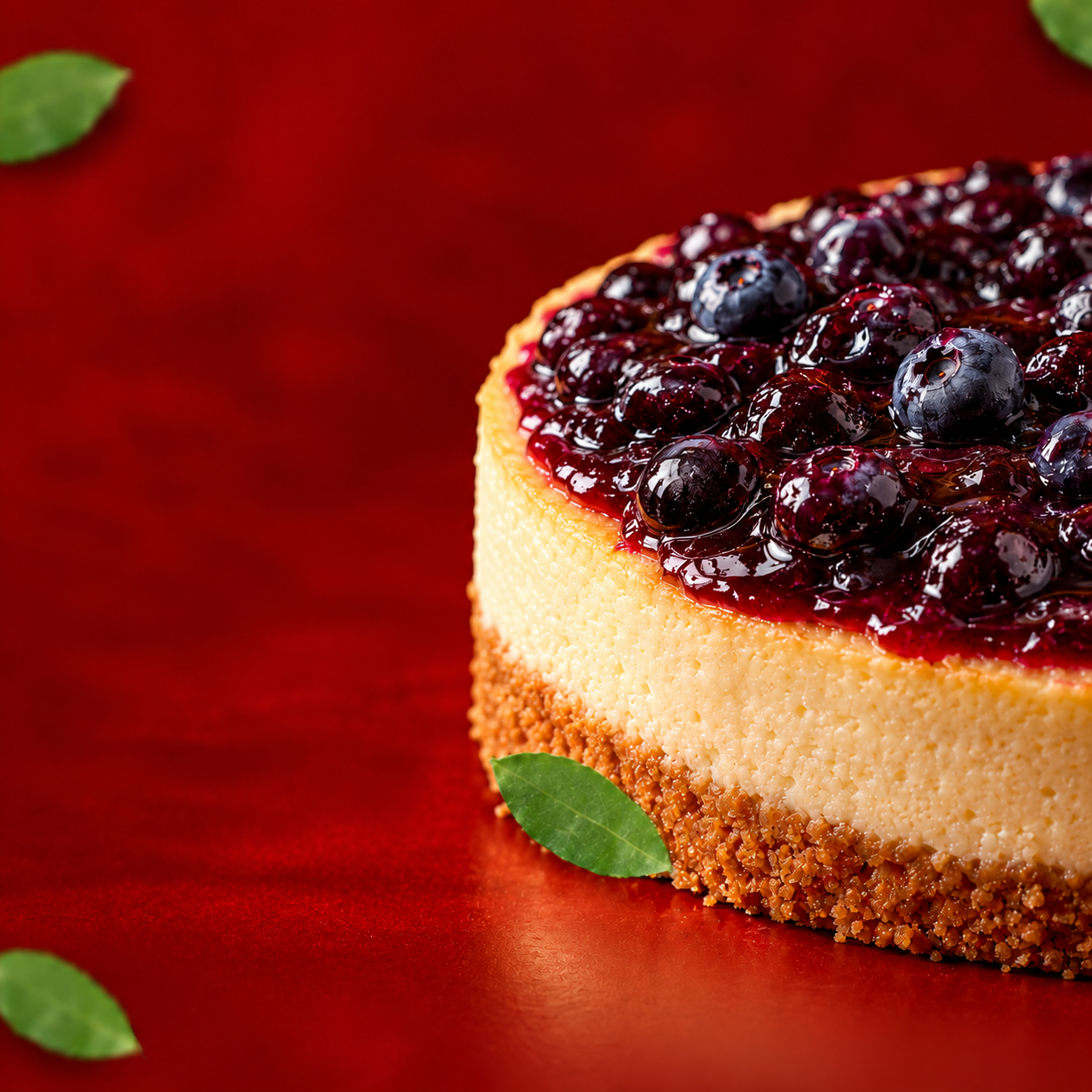
This New York cheesecake recipe gives you the dense, creamy, slightly tangy cheesecake that bakeries are famous for. It uses simple ingredients, exact measurements, and a gentle water bath so the top stays smooth instead of cracking.
Below you will find the full recipe, then a troubleshooting guide for the problems home bakers run into most often: cracks, a runny center, a soggy crust, and a grainy filling.
What Makes New York Cheesecake Different?
New York cheesecake is richer and heavier than most other styles. It uses a high proportion of full-fat cream cheese, plus sour cream or heavy cream, and very little flour. As a result, you get a thick, smooth slice that holds a clean edge.
Other styles feel different. Japanese cheesecake is light and airy because whipped egg whites are folded into the batter. Italian versions often use ricotta, which gives a lighter, slightly grainy texture. No-bake cheesecake sets in the fridge instead of the oven and is softer and more mousse-like.
New York Cheesecake Recipe at a Glance
- Prep time: 30 minutes
- Bake time: 60–75 minutes, plus 1 hour cooling in the oven
- Chill time: at least 8 hours (overnight is best)
- Pan: 23 cm (9-inch) springform pan
- Serves: 12 slices
New York Cheesecake Ingredients
For the crust
- 200 g (about 1¾ cups) digestive biscuit or graham cracker crumbs
- 80 g (5½ tablespoons) unsalted butter, melted
- 2 tablespoons sugar
For the filling
- 900 g (four 8-oz blocks) full-fat cream cheese, at room temperature
- 200 g (1 cup) granulated sugar
- 25 g (3 tablespoons) all-purpose flour
- 160 g (⅔ cup) full-fat sour cream, at room temperature
- 4 large eggs, at room temperature
- 2 teaspoons vanilla extract
- 1 tablespoon lemon juice
- ¼ teaspoon salt
How to Make New York Cheesecake
- Prepare the pan. First, heat the oven to 175°C (350°F). Wrap the outside of the springform pan in two layers of heavy-duty foil so water from the water bath cannot leak in.
- Make the crust. Next, mix the biscuit crumbs, melted butter, and sugar until the mixture looks like wet sand. Press it firmly into the bottom of the pan with the base of a glass.
- Pre-bake the crust. Then bake for 10 minutes, then let it cool while you make the filling. Lower the oven to 160°C (325°F).
- Beat the cream cheese. After that, beat the cream cheese on low speed until completely smooth, about 2 minutes. Scrape the bowl and paddle well.
- Add sugar and flour. Next, add the sugar, flour, and salt and beat on low until smooth. Mix in the sour cream, vanilla, and lemon juice.
- Add the eggs gently. Then add the eggs one at a time on the lowest speed, mixing only until each one disappears. Stop as soon as the batter is smooth.
- Fill and set up the water bath. After that, pour the filling over the crust and tap the pan on the counter to release air bubbles. Place the pan in a large roasting pan and pour hot water into the roasting pan to come about 2.5 cm (1 inch) up the sides.
- Bake. Next, bake for 60–75 minutes, until the edges are set and the center 5–7 cm (2–3 inches) still wobbles slightly when you gently shake the pan.
- Cool slowly. Then turn off the oven, open the door a few centimeters, and leave the cheesecake inside for 1 hour.
- Chill. Finally, remove from the water bath and foil, run a thin knife around the edge, and cool to room temperature. Refrigerate uncovered for at least 8 hours before slicing.
Common New York Cheesecake Problems and How to Fix Them
Why did my cheesecake crack?
Cause: Cracks usually come from too much heat, overbaking, or a sudden temperature change. They also happen when the cheesecake sticks to the pan and pulls apart as it shrinks while cooling.
Fix: Bake at 160°C (325°F) in a water bath, stop when the center still wobbles, and cool slowly in the turned-off oven. Run a knife around the edge before chilling. A crack does not change the flavor, so you can hide it with a fruit topping or sour cream layer. For a deeper guide, read why cheesecake cracks and how to prevent it.
Why is my cheesecake runny in the middle?
Cause: It was underbaked, or it was not chilled long enough. Also, a cheesecake keeps setting as it cools.
Fix: The center should wobble like set jelly, not ripple like liquid. If it is still runny after 8 hours in the fridge, return it to a 160°C (325°F) oven in a water bath for 15–20 minutes, then cool and chill again.
Why is my cheesecake grainy or lumpy?
Cause: Cold cream cheese. Because cold blocks never fully smooth out, they leave small lumps in the batter.
Fix: Leave the cream cheese, eggs, and sour cream out for 1–2 hours before baking. Beat the cream cheese alone until perfectly smooth before adding anything else.
Why is my cheesecake crust soggy?
Cause: Water leaked into the pan from the water bath, or the crust was not pre-baked.
Fix: Use two layers of heavy-duty foil, or set the springform inside a slightly larger cake pan before placing it in the water. Also, always pre-bake the crust for 10 minutes.
Why did my cheesecake puff up and then sink?
Cause: Too much air was beaten into the batter, usually after the eggs went in.
Fix: Use low speed for the whole recipe and mix the eggs only until combined. Tap the filled pan on the counter to bring bubbles to the surface.
Tips for Success With This New York Cheesecake Recipe
- Use full-fat cream cheese in blocks rather than the spreadable tub kind, because tub cream cheese contains more water and sets softer.
- Scrape the bowl several times. Otherwise, unmixed streaks of cream cheese become lumps in the baked cheesecake.
- For clean slices, dip a sharp knife in hot water and wipe it dry between each cut.
- Bake it a day ahead if you can, since the flavor and texture are better after a full night in the fridge.
Popular Variations
- Strawberry cheesecake: top the chilled cheesecake with a fresh strawberry glaze. See our strawberry cheesecake recipe.
- Chocolate cheesecake: use a chocolate cookie crust and add 170 g melted dark chocolate to the filling after the sour cream.
- Lotus Biscoff cheesecake: use Biscoff biscuits for the crust and spread warm Biscoff spread over the top.
- No-bake cheesecake: if you do not want to use the oven, follow our guide to a firm no-bake cheesecake without gelatin.
How to Store New York Cheesecake
Once cooled, cover and then refrigerate cheesecake for up to 5 days. To freeze, chill it completely, wrap whole or sliced pieces tightly in plastic wrap and foil, and freeze for up to 2 months. Thaw overnight in the fridge.
A Short History of Cheesecake
Sweet cheese cakes made with fresh cheese, honey, and grain go back to the ancient Mediterranean. The modern New York style took shape in the early 20th century, after cream cheese became widely available in the United States and New York delis and restaurants made the dense, rich version famous. Cheesemaking itself is far older: archaeologists have found evidence of cheesemaking from about 7,000 years ago.
New York Cheesecake Recipe FAQ
Can I make cheesecake without a water bath?
Yes. Place a pan of hot water on the rack below the cheesecake instead. This adds steam to the oven and still helps prevent cracks, without any risk of a soggy crust.
Can I use low-fat cream cheese?
It is not recommended. Low-fat cream cheese contains more water, so the cheesecake sets softer and can taste watery.
How do I know when cheesecake is done?
The edges should look set and slightly puffed, and the center should wobble gently in one piece when you nudge the pan. If you use a thermometer, the center should read about 65–66°C (150°F).
Why does cheesecake need to chill overnight?
The filling finishes setting as it chills, so slicing it warm or after only a few hours gives a soft, sticky texture.
Keep baking with us. If you enjoyed this New York cheesecake recipe, our digital cookbook has 31 more recipes like this one, ready to print or read on your phone.
Chocolate Lazy Cake: Origin, Ingredients, Texture and Popularity