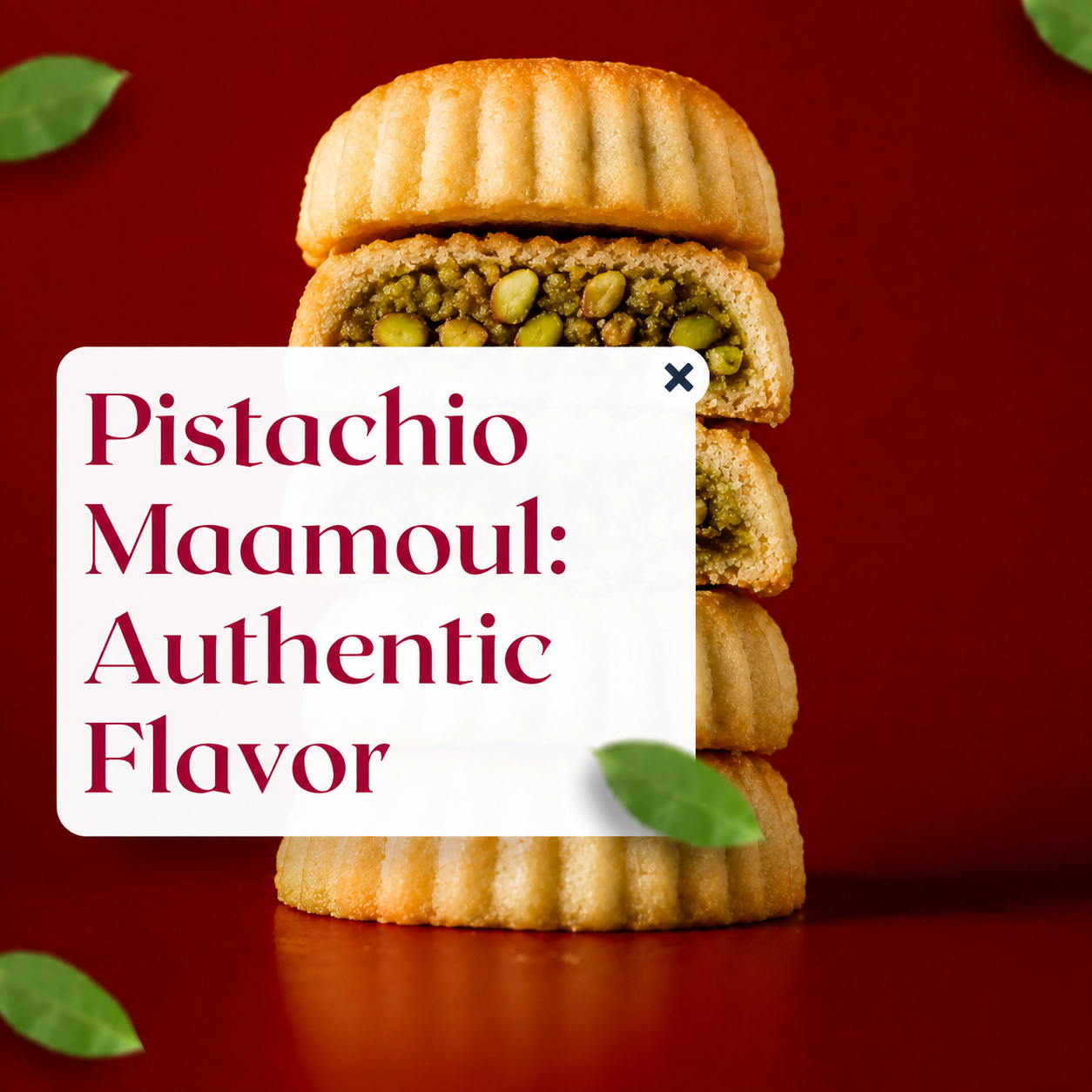
Pistachio maamoul is one of the most elegant and highly valued varieties of traditional Middle Eastern maamoul. It combines a delicate semolina pastry with a rich green pistachio filling, creating a distinctive balance of crumbly texture, nutty flavor, and floral aroma.
Maamoul is more than an ordinary sweet. It is closely associated with hospitality, family gatherings, religious holidays, and the preservation of traditional culinary skills. In many households, preparing maamoul is a shared activity through which recipes and techniques are passed from one generation to the next .
What Is Pistachio Maamoul?
Pistachio maamoul is a small baked pastry usually made from semolina or a mixture of semolina and flour. The dough is enriched with ghee or butter and may be scented with rose water, orange blossom water, or mahlab.
The filling is traditionally prepared from chopped or finely ground pistachios mixed with sugar. Rose water or orange blossom water is often added to enhance the aroma and complement the natural flavor of the nuts. The pastry is then shaped by hand or pressed into a carved mold before being baked until lightly golden.
Dates, walnuts, and pistachios are considered the three most familiar traditional maamoul fillings, although other regional variations also exist.
The Origin of Maamoul
The exact origin of maamoul cannot be attributed with certainty to one modern country. Filled pastries made with dates or nuts have existed in the Middle East for centuries, and different communities developed their own versions according to local customs and available ingredients.
The maamoul known today is especially associated with the Levant, including Lebanon, Syria, Palestine, and Jordan. Related pastries can also be found in Iraq, Egypt, Turkey, the Arabian Peninsula, and other parts of the region.
Food historians have connected maamoul with earlier Middle Eastern pastries, including Egyptian kahk and Iraqi kleicha. These related sweets changed in shape, name, and composition over time while remaining strongly connected to religious celebrations and seasonal gatherings. Maamoul is therefore best understood as part of a shared regional heritage rather than the invention of a single country.
Why Is It Called Maamoul?
The word maamoul is derived from the Arabic verb ʿamila, meaning “to make” or “to prepare.” Its name can be understood as referring to something carefully made by hand.
This meaning suits the pastry well because traditional maamoul requires time and attention. Each piece must be filled, sealed, shaped, decorated, and arranged separately before baking. When large quantities are prepared for a holiday, the work is often divided among several family members.
Why Are Pistachios Used in Maamoul?
Pistachios give maamoul a deep nutty flavor, a gently crunchy texture, and a distinctive green filling. Their flavor pairs especially well with the richness of ghee or butter and the floral fragrance of rose water or orange blossom water.
The nuts are generally chopped finely enough to create a cohesive filling while retaining some texture. Sugar provides sweetness, while floral water adds aroma and helps bring the filling together.
Compared with the smooth sweetness of date maamoul, the pistachio variety has a lighter, nuttier character. It is often regarded as a refined choice for festive tables, hospitality trays, and gift boxes.
Traditional Ingredients
The ingredients vary between regions, bakeries, and family recipes, but traditional pistachio maamoul commonly contains:
- Fine or coarse semolina
- Flour in some versions
- Ghee or butter
- Sugar
- Milk or water
- Rose water or orange blossom water
- Yeast, baking powder, or neither, depending on the recipe
- Pistachios for the filling
- Mahlab or other aromatic ingredients in some traditions
The filling is usually made from pistachios, sugar, and floral water. Some recipes combine pistachios with a small amount of another nut, although pure pistachio filling is generally considered the classic premium version.
The finished pastry should have a tender, crumbly shell rather than a hard or heavily browned exterior.
Decorative Molds and Traditional Shapes
One of the most recognizable features of pistachio maamoul is its detailed decoration. Traditional molds are commonly carved from wood and feature geometric, floral, shell-like, or sunburst patterns.
After the dough is filled and sealed, it is placed inside the mold and pressed gently. The mold is then tapped against a surface so that the decorated pastry is released without damaging its pattern. These designs are not always purely ornamental. Many families and bakeries use different molds or shapes to distinguish pistachio maamoul from pieces filled with dates or walnuts. However, the exact design assigned to each filling differs among regions and households
Pistachio Maamoul and Religious Celebrations
Pistachio maamoul is strongly connected to festive occasions throughout the Middle East. Muslim families commonly prepare it for Eid al-Fitr, which marks the end of Ramadan, as well as for Eid al-Adha. It is offered to relatives, neighbors, and guests, usually with Arabic coffee or tea.
Many Arab Christian families prepare maamoul for Easter and Christmas. Related maamoul traditions have also appeared in Jewish holiday celebrations in parts of the region.
Its presence during different religious festivals demonstrates how traditional foods can be shared across communities while carrying special meanings within each family.
A Family Tradition Passed Through Generations
Making pistachio maamoul is often a social occasion rather than an individual cooking task. Before a holiday, family members may gather to prepare several trays at once.
One person may mix the dough, another may divide the pistachio filling, while others shape the pieces and press them into molds. Children often help by arranging the pastries on trays or learning how to create the traditional patterns.
Through these gatherings, family recipes and preparation methods are preserved. Even when households use similar ingredients, each family may have its own preferred dough texture, filling sweetness, mold design, or balance of rose and orange blossom water. Maamoul preparation is consequently viewed as a symbol of sharing, cooperation, and togetherness.
What Makes Pistachio Maamoul Special?
Pistachio maamoul is distinguished by the contrast between its pale, tender pastry and its rich green filling. The outer shell is delicate and crumbly, while the interior is nutty, slightly crunchy, and gently sweet.
The combination of pistachios, ghee, semolina, and floral water gives it a flavor strongly associated with traditional Middle Eastern confectionery. Unlike desserts soaked in syrup, maamoul generally offers a more restrained sweetness, especially when served with unsweetened coffee or tea.
Some varieties are lightly dusted with powdered sugar after cooling, while others are served without additional decoration so that the molded pattern remains clearly visible.
How Pistachio Maamoul Is Served
Pistachio maamoul is usually arranged on a serving tray and offered with Arabic coffee, black coffee, or tea. The bitterness of the beverage complements the richness of the dough and the sweetness of the nut filling.
During holidays, it may be served alongside date and walnut maamoul, allowing guests to choose among several fillings. It is also commonly presented in decorative boxes as a gift for relatives, friends, hosts, or business associates.
Because it can be prepared in advance and stored in a sealed container, maamoul is particularly convenient for occasions involving several days of visits and celebrations.
Pistachio Maamoul Today
Today, pistachio maamoul is sold far beyond traditional homes and neighborhood bakeries. It can be found in supermarkets, specialist Middle Eastern shops, online stores, luxury confectionery businesses, and international gift collections.
Arab communities living abroad have helped introduce maamoul to wider audiences. Modern manufacturers now offer individually wrapped pieces, miniature versions, premium gift boxes, and contemporary flavors.
Despite the growth of commercial production, handmade pistachio maamoul retains a special cultural value. The delicate patterns and slight differences between individual pieces reflect the work of the person who shaped them and preserve the character of traditional home baking.
More Than a Sweet Pastry
Pistachio maamoul represents more than its ingredients. It carries associations with hospitality, generosity, celebration, and family memory.
Its fragrance may remind people of preparations before Eid or Easter, while its carved patterns reflect skills passed down through generations. Offering maamoul to guests is also a gesture of welcome and an invitation to share in the happiness of an occasion.
Conclusion
Pistachio maamoul is one of the most distinctive pastries in Middle Eastern culinary tradition. Its tender semolina shell, fragrant pistachio filling, and beautifully molded surface give it an elegant appearance and memorable flavor.
Its long connection with holidays, hospitality, and family gatherings has allowed it to remain popular across generations. Whether handmade at home, purchased from a traditional bakery, or presented in a luxurious gift box, pistachio maamoul continues to tell a story of craftsmanship, generosity, and shared cultural heritage.
READ MORE : What is the Best Sugar Syrup (Attar) Ratio for Knafeh?