Coconut balls are simple and popular sweets enjoyed in many countries around the world.
These treats have become a favorite choice for homes, celebrations, and special occasions because they are easy to serve and can be prepared in many different styles and flavors. They may be coated with shredded coconut, chocolate, nuts, or other decorative ingredients.
The Origin of Coconut Balls
It is difficult to identify one country as the original birthplace of coconut balls because small coconut-based sweets have appeared in many cuisines around the world.
Coconut has been used for centuries in tropical regions of Asia, Africa, and Latin America. Over time, it also became popular in European and Middle Eastern cuisines and was increasingly used in desserts and confectionery.
As dried coconut, condensed milk, and chocolate became more widely available, many recipes developed that combined these ingredients and shaped them into small balls.
Coconut Is the Main Ingredient
Shredded coconut is the most important ingredient in this dessert.
It provides the distinctive flavor, light aroma, and characteristic texture.
Fresh or dried coconut can be used depending on the recipe, but dried shredded coconut is the most common because it is convenient, easy to store, and simple to use.
Shredded coconut is also often used to coat the outside of the balls, giving them an elegant white appearance and an additional layer of texture.
Simple and Versatile Ingredients
The ingredients used in coconut balls vary from one recipe to another.
Some versions rely on a simple combination of shredded coconut and sweetened condensed milk, while others include sugar, butter, milk, or crushed biscuits.
Vanilla, rose water, or orange blossom water may also be added to create different flavors.
Some varieties include chocolate, cocoa, or nuts.
This flexibility has made coconut balls an easy dessert to adapt according to personal taste and the ingredients available.
Coconut Balls with Condensed Milk
One of the most popular versions combines shredded coconut with sweetened condensed milk.
The condensed milk binds the coconut together while also adding sweetness and a creamy texture.
This version usually requires only a few ingredients and can be shaped easily into small balls before being rolled in additional shredded coconut.
Its simplicity has helped make it a popular homemade dessert in many countries.
Chocolate-Covered Coconut Balls
Coconut pairs particularly well with chocolate, which is why chocolate-covered coconut balls have become one of the most popular modern varieties.
Dark, milk, or white chocolate can be used to coat the balls completely or simply to decorate them.
The combination creates an appealing contrast between the sweetness of the coconut and the rich flavor of chocolate.
This version is also popular in pastry shops, gift boxes, and special occasions.
Nuts and Fillings
A whole almond, hazelnut, or pistachio can be placed inside each coconut ball.
The nuts add a crunchy texture and a different flavor to the soft coconut mixture.
Ground nuts may also be mixed directly with the coconut or used as an outer coating.
Some recipes use dried fruit or small pieces of chocolate as a filling.
Do Coconut Balls Need to Be Baked?
Many modern recipes are no-bake desserts, in which the ingredients are mixed, shaped, and chilled in the refrigerator.
However, there are also baked versions, especially recipes made with coconut, egg whites, and sugar.
As a result, coconut balls can be soft and chilled or baked with a lightly golden exterior, depending on the recipe.
Coconut Balls vs. Coconut Macaroons
Coconut macaroons are generally baked and usually contain shredded coconut, sugar, egg whites, or similar ingredients. Their exterior becomes lightly golden during baking.
No-bake coconut balls, on the other hand, are usually shaped by hand after coconut is mixed with an ingredient that helps bind it together, such as sweetened condensed milk.
Although both desserts feature coconut as a main ingredient, their preparation methods and textures are quite different.
Coconut Balls for Special Occasions
Their small size is one of the main reasons coconut balls are so popular.
They are easy to serve at holidays, birthday parties, family gatherings, and buffets.
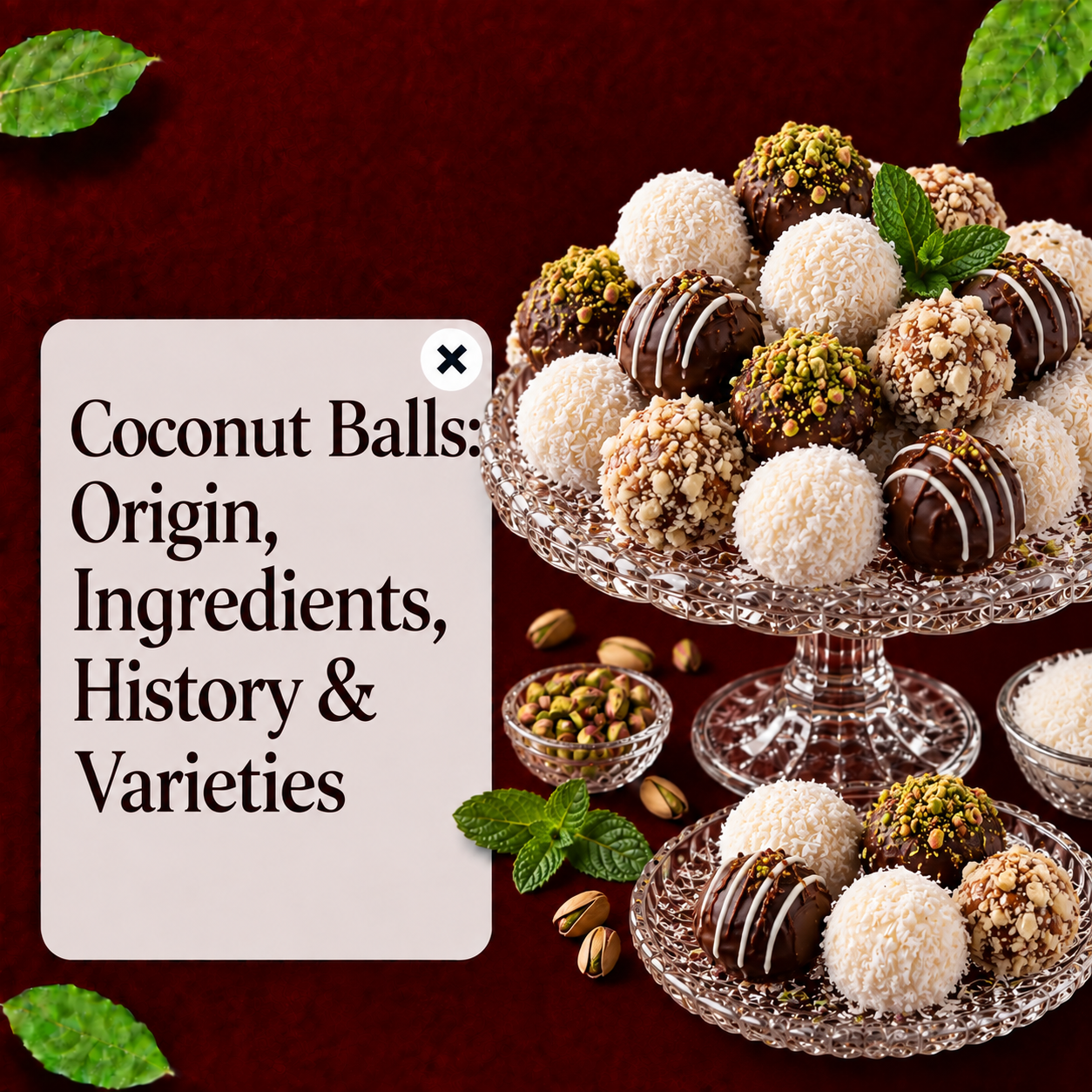
Several varieties can be prepared at the same time, such as classic white coconut balls, chocolate-covered versions, or balls decorated with pistachios.
For this reason, they are often included in assortments of small sweets and bite-sized desserts.
Coconut Balls in the Arab World
Coconut is widely used in modern Arab desserts, particularly in simple homemade sweets.
They are also served during holidays and special occasions alongside biscuits, maamoul, chocolates, and other small sweets.
Preparation methods vary from one country to another, but shredded coconut usually remains the main ingredient.
Coconut Balls Around the World
Coconut-based sweets can be found in India, Southeast Asia, Latin America, Europe, and North America.
In some countries, coconut is combined with milk and sugar to create small sweet balls, while other cultures add chocolate, nuts, spices, or dried fruits.
This wide variety reflects the versatility of coconut as an ingredient that pairs easily with many different flavors.
Ways to Decorate Coconut Balls
Coconut balls can be decorated in many different ways.
Popular coatings and toppings include:
Shredded coconut, chocolate, cocoa powder, ground pistachios, almonds, and powdered sugar.
Thin lines of melted chocolate may also be drizzled over the top, or small pieces of nuts can be added as decoration.
The natural white color of coconut provides a simple base that can easily be enhanced with different colors and ingredients.
A Small Dessert with Endless Variety
The appeal of coconut balls lies in their simplicity and their ability to adapt to a wide range of flavors.
They can be made with only a few ingredients for a simple homemade treat or transformed into a more luxurious dessert with chocolate, nuts, and different fillings.
Thanks to their small size, distinctive coconut flavor, easy presentation, and wide variety of styles, coconut balls have become a favorite sweet for homes and celebrations around the world.
They are a perfect example of how a simple ingredient such as coconut can be transformed into an elegant and versatile dessert that combines simplicity with memorable flavor.
Strawberry Ice Cream: A Classic Flavor Combining Refreshment and Natural Sweetness