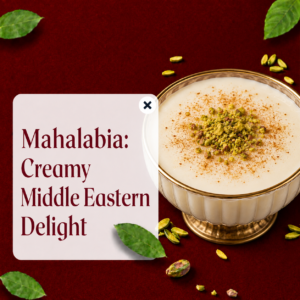
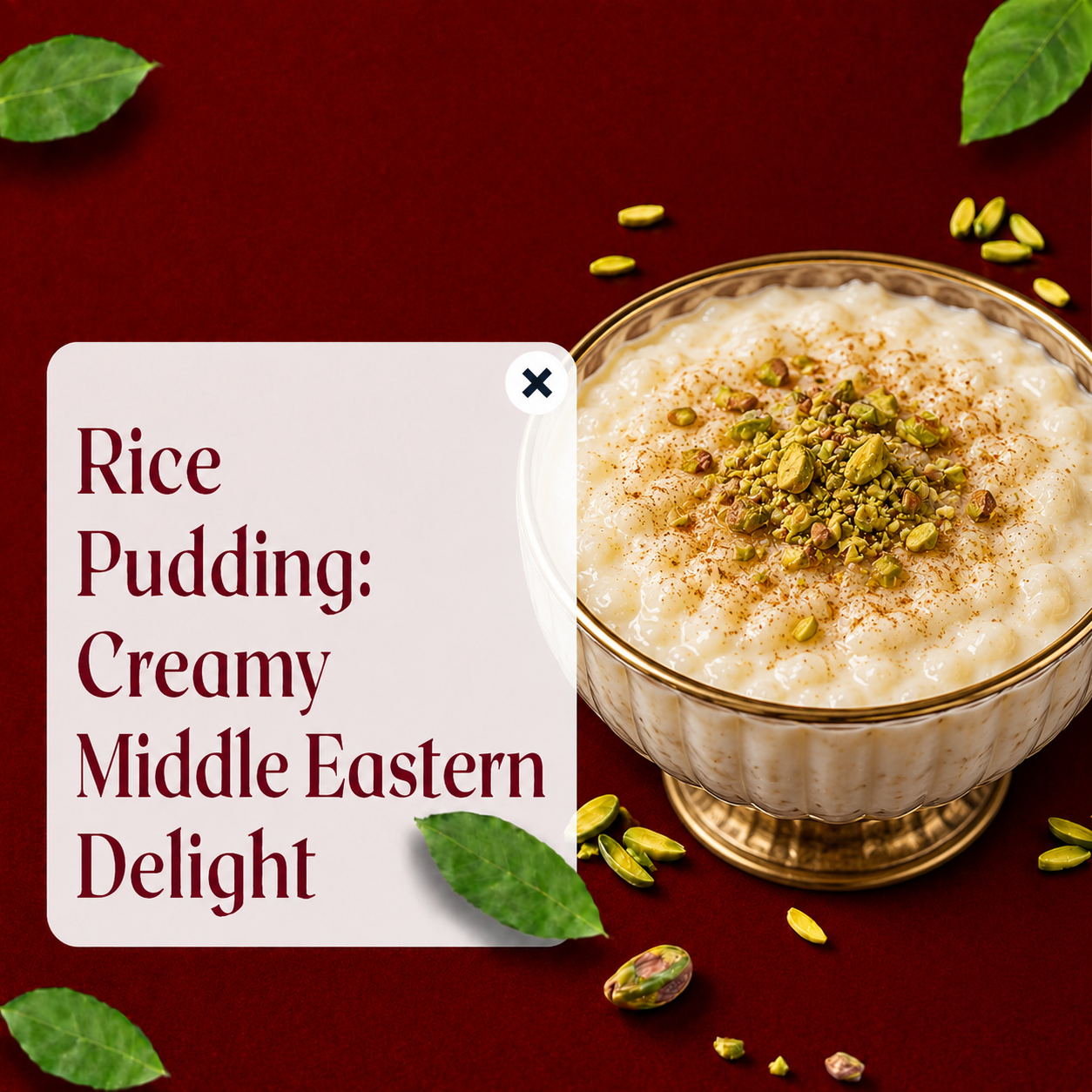
Rice pudding is a simple and comforting dessert enjoyed throughout the Levant and many parts of the Arab world. Made mainly from rice, milk, and sugar, this creamy dessert is often flavored with rose water or orange blossom water and decorated with pistachios, cinnamon, or other nuts.
Despite its simple ingredients, rice pudding has a special place in Middle Eastern home cooking. Its creamy texture and delicate flavor make it suitable for everyday desserts, family gatherings, Ramadan, and special occasions.
It can be served warm during colder months or chilled for a refreshing dessert in summer.
What Is Rice Pudding?
Rice pudding is a milk-based dessert prepared by slowly cooking rice with milk and sugar until the mixture becomes soft and creamy.
The rice releases starch during cooking, which naturally thickens the milk. As a result, the dessert develops its characteristic smooth and rich consistency.
In traditional Middle Eastern versions, rose water or orange blossom water may be added near the end of cooking. These ingredients give the pudding a delicate floral aroma.
The finished dessert is usually served in small bowls or cups and may be topped with pistachios, almonds, cinnamon, coconut, or raisins.
The Origin of Rice Pudding
The exact origin of rice pudding is difficult to trace to a single country.
Desserts combining rice and milk have existed for centuries in different parts of Asia, the Middle East, and Europe. As rice cultivation and trade expanded, many cultures developed their own versions of rice cooked with milk, sugar, spices, and aromatic ingredients.
In the Levant, rice pudding became especially familiar in Lebanon, Syria, Palestine, and Jordan.
Families across the region developed their own variations. Some preferred floral flavors, while others added nuts, cinnamon, or vanilla.
Similar milk-and-rice desserts are also found in Turkey, Egypt, India, Europe, and many other parts of the world.
Therefore, rice pudding is best understood as a dessert with many regional traditions rather than one recipe belonging exclusively to a single culture.
Why Is Rice Pudding So Popular?
One of the main reasons for the popularity of rice pudding is its simplicity.
Its basic ingredients are commonly found in most kitchens:
- Rice
- Milk
- Sugar
Traditional recipes may also include:
- Rose water
- Orange blossom water
- Vanilla
- Pistachios
- Almonds
- Cinnamon
- Coconut
Because the ingredients are simple and affordable, the dessert can easily be prepared for families or larger gatherings.
In addition, its mild sweetness and creamy texture make it appealing to both adults and children.
The Best Rice for Rice Pudding
Choosing the right rice can make a noticeable difference in the texture of the dessert.
Short-grain and medium-grain rice are often preferred because they release more starch while cooking. This starch helps thicken the milk naturally and creates a creamy consistency.
Long-grain rice can also be used, but the final texture may be slightly different.
Some Middle Eastern recipes include a small amount of cornstarch. This produces a thicker texture and can help the pudding hold its consistency after chilling.
The ideal result is rice that becomes very soft while still contributing gentle texture to the dessert.
Milk: The Foundation of Creamy Rice Pudding
Milk is one of the most important ingredients in rice pudding.
Traditional recipes often use whole milk because its higher fat content creates a richer and smoother texture.
As the rice cooks, it gradually absorbs some of the milk. At the same time, starch released from the rice thickens the remaining liquid.
Slow cooking allows these ingredients to come together and creates the creamy consistency associated with traditional rice pudding.
Modern versions may use different types of milk, but the classic preparation is strongly associated with dairy milk.
Rose Water and Orange Blossom Water
One characteristic that distinguishes Middle Eastern rice pudding is the use of floral flavorings.
Rose water and orange blossom water are commonly added in Levantine desserts. Only a small amount is usually needed because their aromas can be quite distinctive.
Some families prefer rose water, while others use orange blossom water. A combination of both may also be used.
These floral notes complement the mild sweetness of the milk and rice.
Vanilla has also become popular in modern recipes. It creates a softer and more familiar flavor, especially for people who are less accustomed to floral aromas.
Popular Rice Pudding Toppings
Rice pudding can be served plain, but toppings are often added for flavor and decoration.
Pistachios are among the most popular choices in the Levant. Their green color creates an attractive contrast with the white pudding.
Other common toppings include:
- Almonds
- Walnuts
- Cinnamon
- Coconut
- Raisins
- Crushed nuts
These toppings can also provide a light crunch that contrasts with the creamy texture of the pudding.
However, decoration varies from one family and region to another. Some people prefer rice pudding without any topping so that the flavor of the milk and rice remains the main focus.
Rice Pudding vs. Muhallabia
Use up and down arrow keys to resize the meta box pane.
Move upMove downShow or hide panel
Use up and down arrow keys to resize the meta box pane.
Move upMove downShow or hide panel
Use up and down arrow keys to resize the meta box pane.
Move upMove downShow or hide panel
Analysis resultsLearn more about the readability analysis(Opens in a new browser tab)
Problems (1)
- Word complexity: Is your vocabulary suited for a larger audience? Yoast SEO Premium will tell you!
Improvements (2)
- Passive voice: 11.9% of the sentences contain passive voice, which is more than the recommended maximum of 10%. Try to use their active counterparts.
- Transition words: Only 24.4% of the sentences contain transition words, which is not enough. Use more of them.
Good results (4)
- Consecutive sentences: There are no repetitive sentence beginnings. That’s great!
- Subheading distribution: Great job!
- Paragraph length: There are no paragraphs that are too long. Great job!
- Sentence length: Great!
PostBlock
Heading 2
Introduce new sections and organize content to help visitors (and search engines) understand the structure of your content.
Generate with Elementor AITransform to variation
Typography
Color
Font sizeFont size
Background
Color
Gradient
Attributes
All options are currently hidden
Advanced
Skip to the selected blockOpen publish panel
- Post
Analysis resultsLearn more about the readability analysis(Opens in a new browser tab)
Problems (1)
- Word complexity: Is your vocabulary suited for a larger audience? Yoast SEO Premium will tell you!
Improvements (2)
- Passive voice: 12.7% of the sentences contain passive voice, which is more than the recommended maximum of 10%. Try to use their active counterparts.
- Transition words: Only 29.1% of the sentences contain transition words, which is not enough. Use more of them.
Good results (4)
- Consecutive sentences: There are no repetitive sentence beginnings. That’s great!
- Subheading distribution: Great job!
- Paragraph length: There are no paragraphs that are too long. Great job!
- Sentence length: Great!
PostBlock
List Item
An individual item within a list.
Typography
Color
Font sizeFont size
Background
All options are currently hidden
Attributes
All options are currently hidden
Advanced
Skip to the selected blockOpen publish panel
- Post
Analysis resultsLearn more about the readability analysis(Opens in a new browser tab)
Problems (1)
- Word complexity: Is your vocabulary suited for a larger audience? Yoast SEO Premium will tell you!
Improvements (1)
- Passive voice: 14.8% of the sentences contain passive voice, which is more than the recommended maximum of 10%. Try to use their active counterparts.
Good results (5)
- Consecutive sentences: There are no repetitive sentence beginnings. That’s great!
- Subheading distribution: Great job!
- Paragraph length: There are no paragraphs that are too long. Great job!
- Sentence length: Great!
- Transition words: Well done!
PostBlock
Paragraph
Start with the basic building block of all narrative.
Typography
Color
Font sizeFont size
Background
Color
Gradient
Attributes
All options are currently hidden
Advanced
Skip to the selected blockOpen publish panel
- Post
Rice pudding and muhallabia may look similar, but they are different desserts.
These grains provide texture and give the dessert its distinctive character.
Muhallabia, by comparison, is generally made by thickening milk with cornstarch, rice flour, or another starch. It normally does not contain whole grains of rice.
As a result, muhallabia usually has a smoother and more uniform consistency.
Both desserts may contain sugar, rose water, orange blossom water, pistachios, or other nuts.
The main difference is therefore the presence of cooked rice grains in rice pudding.
Rice Pudding During Ramadan and Family Gatherings
- Ramadan
- Family gatherings
- Dinner desserts
- Celebrations
- Banquets
- Everyday homemade treats
During summer, chilled rice pudding is especially refreshing.
In colder weather, it can also be served warm, creating a comforting dessert with a rich milky flavor.
This versatility has helped it remain popular across generations.
Rice Pudding Around the World
The concept of cooking rice with milk appears in many cuisines.
Recipes differ according to local traditions.
Some versions contain cinnamon or vanilla. Others include cardamom, nuts, dried fruit, floral water, or different types of sweeteners.
Cooking techniques also vary. Some versions are thick and creamy, while others have a thinner consistency.
Despite these differences, they all demonstrate how simple ingredients such as rice and milk can develop into distinctive desserts across different cultures.
Why Is Middle Eastern Rice Pudding Special?
Middle Eastern rice pudding is especially recognizable because of its combination of creamy texture and delicate aromatic flavor.
Its main characteristics often include:
- Soft cooked rice
- Creamy milk
- Gentle sweetness
- Rose water or orange blossom water
- Pistachios or other nuts
The floral aroma gives Levantine versions a distinctive character compared with many Western rice puddings.
At the same time, recipes remain flexible. Each family may adjust the sweetness, texture, fragrance, and toppings according to personal preference.
This variety is part of what has allowed the dessert to remain popular over time.
A Simple Dessert with Lasting Tradition
Rice pudding proves that a memorable dessert does not need complicated ingredients.
Rice, milk, and sugar form the foundation, while rose water, orange blossom water, vanilla, or nuts can add additional flavor and character.
For generations, families throughout the Levant and the wider Arab world have prepared rice pudding as a simple homemade sweet.
Its creamy texture, gentle flavor, and connection with family cooking have helped it remain a familiar part of Middle Eastern dessert traditions.
Whether served warm or chilled, rice pudding continues to bring together simplicity, comfort, and traditional flavor in every bowl.