Fine Nabulsi Knafeh is one of the most famous traditional Palestinian desserts. Closely connected with the city of Nablus in Palestine, this distinctive sweet has become an important symbol of the city’s culinary heritage.
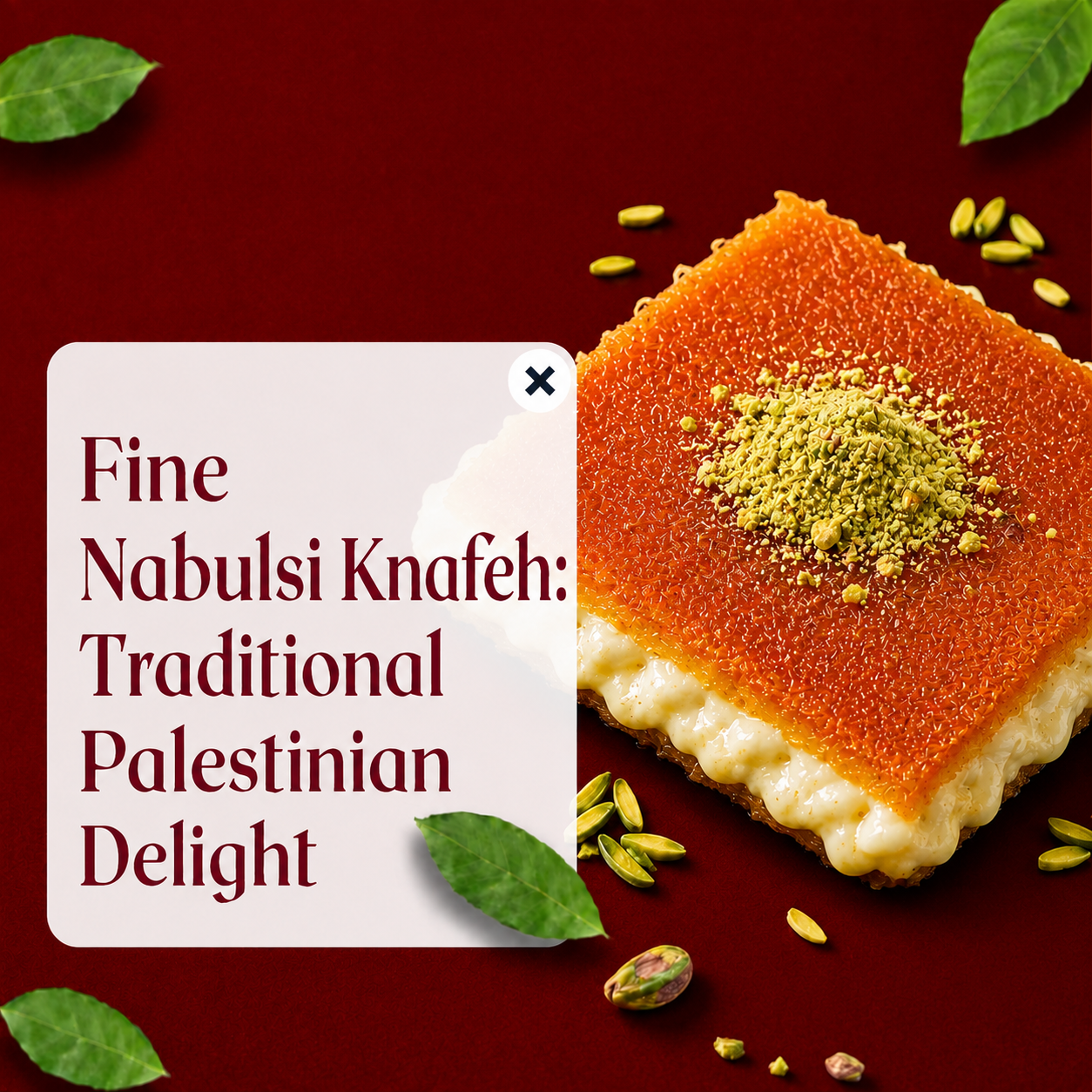
The dessert is known for its smooth, golden pastry layer covering warm melted cheese. After cooking, fragrant sugar syrup is poured over the knafeh, and ground pistachios are often added as a finishing touch.
What makes Fine Nabulsi Knafeh especially distinctive is the balance between flavors and textures. The mild saltiness of the cheese contrasts with the sweetness of the syrup, while ghee and orange blossom water add richness and aroma.
What Is Fine Nabulsi Knafeh?
Fine Nabulsi Knafeh is a cheese-filled variety of knafeh traditionally associated with Nablus.
Unlike coarse knafeh, which contains long and clearly visible strands of shredded pastry, the fine version has a much smoother surface. The pastry is processed into a fine texture before being combined with ghee and cooked until golden.
A layer of cheese sits beneath the pastry. Once heated, the cheese becomes soft and melted, creating the characteristic texture for which this Palestinian dessert is known.
Sugar syrup is then added while the knafeh is still warm, and pistachios may be sprinkled over the surface.
The Origin of Fine Nabulsi Knafeh
Knafeh has a long history in Middle Eastern cuisine, and several versions are found across the region.
However, Nabulsi Knafeh is especially associated with the Palestinian city of Nablus. The city became famous not only for its knafeh but also for the traditional Nabulsi cheese used in the dessert.
Different historical accounts exist regarding the earliest origins of knafeh. Therefore, it is difficult to identify one definitive story explaining when the dessert first appeared.
Nevertheless, the version known as Nabulsi knafeh has become deeply rooted in Palestinian culinary heritage.
Over the years, its popularity spread from Nablus to other Palestinian cities and throughout Jordan, Syria, Lebanon, the Gulf region, and other parts of the Arab world.
Today, Fine Nabulsi Knafeh is recognized as one of the best-known Palestinian and Middle Eastern sweets.
Why Is It Called Fine Knafeh?
The word fine refers to the texture of the pastry used to create the top layer.
Fine knafeh has a smooth and finely processed texture. After cooking, it forms an even golden surface over the cheese.
By comparison, coarse knafeh is prepared with long, visible strands of shredded pastry. Those strands produce a more textured and crispy appearance.
Therefore, the terms fine and coarse mainly describe the form of the pastry rather than the type of cheese used in the dessert.
The fine pastry is usually combined with ghee, which helps create its golden appearance and rich flavor.
Nabulsi Cheese and Its Traditional Role
One of the most important ingredients in Fine Nabulsi Knafeh is Nabulsi cheese.
Nabulsi cheese is a traditional white brined cheese associated with Palestine and particularly with the city of Nablus. Traditionally, it has often been produced from sheep’s milk, although other milk may also be used.
The cheese has a salty flavor because it is preserved in brine. For this reason, it is normally soaked in water before being used in desserts.
Soaking helps reduce excess salt while allowing the cheese to maintain its characteristic texture.
When heated, the cheese softens and creates the warm, melted layer found beneath the fine pastry.
In places where traditional Nabulsi cheese is difficult to find, Akkawi cheese or other mild melting cheeses may sometimes be used. However, Nabulsi cheese remains strongly associated with the traditional identity of the dessert.
Main Ingredients in Fine Nabulsi Knafeh
Although the dessert has a rich and distinctive flavor, it is based on a relatively small number of important ingredients:
- Fine knafeh pastry
- Nabulsi cheese
- Ghee
- Sugar syrup
- Orange blossom water or rose water
- Ground pistachios
Each ingredient contributes something different.
The pastry creates the smooth golden surface, while the cheese provides softness and a slightly salty contrast. Ghee adds richness and helps the pastry cook evenly.
Meanwhile, the syrup provides sweetness and moisture. Floral water may also be added to give the dessert its familiar Middle Eastern fragrance.
Sugar Syrup and Orange Blossom Water
Sugar syrup is another essential element of traditional Fine Nabulsi Knafeh.
The syrup is generally prepared from sugar and water. Depending on the tradition, it may also contain orange blossom water or rose water.
These floral ingredients provide a delicate aroma that complements the flavor of the cheese and ghee.
The syrup is usually poured over the knafeh while the dessert is still warm. However, the amount can vary according to personal preference.
Too much syrup can make the pastry excessively soft. Therefore, a balanced amount allows the dessert to remain flavorful without losing its characteristic texture.
Fine Knafeh vs. Coarse Knafeh
The most noticeable difference between fine and coarse knafeh is the pastry.
Fine knafeh has a smooth, finely processed surface. Its pastry resembles small crumbs or grains after preparation.
Coarse knafeh, in contrast, contains long, thin strands of shredded pastry. These strands become golden and noticeably crispy during cooking.
Both styles can be prepared with cheese.
It is also important to distinguish between the terms Nabulsi and fine. Nabulsi refers to the culinary tradition associated with Nablus, while fine describes the texture of the pastry.
As a result, not every cheese knafeh is necessarily Nabulsi, and the word fine refers primarily to the pastry style.
Why Is Nabulsi Knafeh Orange?
The golden-orange appearance of Nabulsi knafeh is one of its most recognizable characteristics.
The exact color can vary between bakeries and preparation methods.
In some cases, the golden color develops from the cooking of the pastry and ghee. Some commercial pastry makers may also use a small amount of food coloring to create the bright orange appearance commonly associated with the dessert.
However, color is not the main measure of quality.
The flavor and texture depend more on the quality of the cheese, pastry, ghee, syrup, and the skill of the pastry maker.
Pistachios as a Traditional Finishing Touch
Ground pistachios are commonly sprinkled over freshly prepared Fine Nabulsi Knafeh.
Their green color provides an attractive contrast with the golden or orange pastry surface. In addition, pistachios add a delicate nutty flavor and a slight crunch.
Although they are an iconic part of the dessert’s presentation, the main identity of Nabulsi knafeh still comes from its two central layers: fine pastry and melted cheese.
Fine Nabulsi Knafeh and the Identity of Nablus
In Nablus, knafeh is much more than a popular sweet.
It has become part of the city’s cultural and culinary identity. Traditional pastry shops have prepared and served it for generations, helping preserve its connection with local food culture.
Visitors to Nablus often seek out traditional sweet shops to experience freshly prepared Nabulsi knafeh.
Large trays of warm knafeh are a familiar sight in traditional bakeries and markets. The dessert is typically cut into portions and served soon after cooking so that the cheese remains warm and soft.
This long-standing tradition has helped make Fine Nabulsi Knafeh one of the foods most closely associated with Nablus.
Knafeh During Ramadan and Celebrations
Knafeh has an important place at social and family occasions throughout Palestine and the wider Levant.
It is commonly served during:
- Ramadan
- Eid celebrations
- Weddings
- Graduation celebrations
- Family gatherings
- Banquets
- Special occasions
Many people prefer to eat knafeh while it is still warm because the cheese remains soft and melted.
The combination of warm cheese, fine pastry, fragrant syrup, and pistachios makes it particularly popular when served fresh.
Fine Nabulsi Knafeh Around the World
The popularity of Fine Nabulsi Knafeh is no longer limited to Palestine.
As Palestinian and other Arab communities established restaurants, bakeries, and pastry shops abroad, knafeh reached new audiences around the world.
Today, this dessert can appear under several English spellings and names, including:
- Nabulsi Knafeh
- Knafeh Nabulsiyeh
- Kanafeh
- Knafeh
- Kunafa
- Konafa
Although spelling and preparation methods vary, these names often refer to closely related forms of the traditional Middle Eastern dessert.
Modern versions may also introduce different cheeses, toppings, or presentation styles. Nevertheless, traditional Fine Nabulsi Knafeh remains strongly connected with the culinary heritage of Palestine and Nablus.
Why Is Fine Nabulsi Knafeh So Popular?
Several characteristics have helped Fine Nabulsi Knafeh remain popular for generations.
First, it combines contrasting flavors. Sweet syrup is balanced by mildly salty cheese, while ghee and floral water add richness and fragrance.
Second, its textures are equally distinctive. The smooth pastry surface contrasts with the warm, soft cheese underneath.
Finally, the dessert carries an important cultural connection with Nablus and Palestinian cuisine.
Together, these qualities make it more than simply a sweet dish. It represents both a culinary experience and a food tradition that has been preserved across generations.
A Palestinian Dessert That Carries the Name of Nablus
Fine Nabulsi Knafeh brings together fine pastry, melted Nabulsi cheese, ghee, fragrant sugar syrup, and pistachios in one of the most recognizable desserts of Palestinian cuisine.
Its close relationship with Nablus has helped transform the dessert into an important symbol of the city’s culinary heritage.
From traditional pastry shops in Palestine to Middle Eastern bakeries around the world, Fine Nabulsi Knafeh continues to attract people with its combination of sweetness, warm cheese, delicate aroma, and distinctive texture.
More importantly, it continues to carry the name and culinary heritage of Nablus and Palestine to new generations around the world.