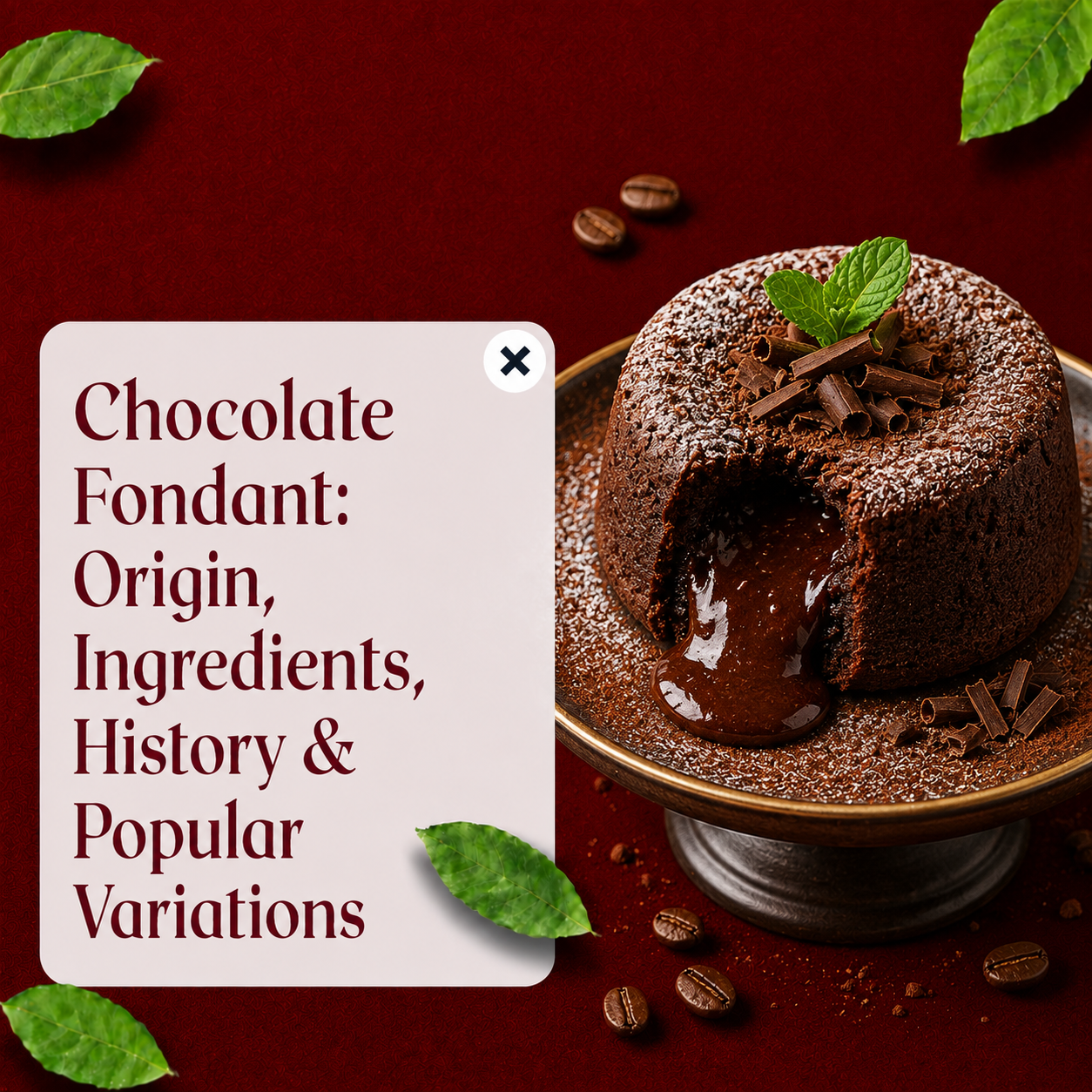
Chocolate Fondant is a popular chocolate dessert known for its rich flavor, soft baked exterior, and warm molten center. Also known as Molten Chocolate Cake or Chocolate Lava Cake, it has become a favorite dessert in restaurants and cafés around the world.
The highlight of Chocolate Fondant is its soft, flowing chocolate center. When the cake is cut open, warm chocolate melts onto the plate, creating a rich texture and an impressive presentation. This unique combination of a firm exterior and molten interior makes Chocolate Fondant especially popular among chocolate lovers.
What Is Chocolate Fondant?
The dessert usually relies on a few rich and simple ingredients, including:
Chocolate, butter, eggs, sugar, and a small amount of flour.
The high proportion of chocolate and butter compared with flour gives the dessert its rich and dense texture.
Chocolate fondant is generally served hot or warm shortly after it comes out of the oven so that the center retains its flowing consistency.
The Origin of Molten Chocolate Fondant
The modern history of the molten-centered dessert is particularly associated with French chef Michel Bras, who created a dessert called Coulant au Chocolat in 1981 after a long period of experimentation.
His original idea involved placing a frozen center of chocolate ganache inside chocolate cake batter. During baking, the ganache melted while the surrounding cake cooked, leaving a liquid center when served.
According to Bras’s account, the inspiration came from a family memory of returning from skiing and enjoying hot chocolate. He wanted to create a dessert that would reproduce that same warm and comforting sensation when opened.
Jean-Georges and the Rise of Lava Cake
Another famous version of the dessert is associated with French chef Jean-Georges Vongerichten, who helped popularize a chocolate cake with an underbaked center in New York restaurants during the 1980s and 1990s.
His method differed from Michel Bras’s approach. Rather than necessarily placing a frozen ball of ganache inside the batter, it relied on carefully controlling the baking time so that the outside cooked while the center remained molten.
Why Is It Called Lava Cake?
The word lava refers to molten rock flowing from a volcano.
The name comes from the way hot chocolate flows from the center of the cake when it is cut open, resembling molten lava pouring from the inside.
This dramatic appearance has helped make the dessert visually appealing, especially when served immediately after baking.
Are Chocolate Fondant and Lava Cake the Same Thing?
In French cuisine, Fondant au Chocolat can refer to a dense, soft chocolate cake that “melts in the mouth,” and it does not necessarily have a completely liquid center.
A cake with a flowing chocolate center may also be called Coulant au Chocolat or Mi-Cuit au Chocolat.
In traditional French usage, fondant does not always mean a cake with a molten center, although internationally the term has increasingly been used to describe lava-style cakes as well.
Chocolate Is the Main Ingredient
The quality of chocolate fondant depends greatly on the type of chocolate used.
Dark chocolate is especially popular because it provides a strong cocoa flavor and helps balance the sweetness of the sugar and richness of the butter.
Because the recipe contains relatively few ingredients, the quality and flavor of the chocolate have a major influence on the character of the finished dessert.
The Role of Butter
Butter is one of the essential ingredients in chocolate fondant.
It gives the cake a rich and tender texture and helps the chocolate form a smooth mixture.
The fats in both butter and chocolate also contribute to the creamy, flowing texture of the center when the dessert is served warm.
Eggs and the Texture of Fondant
Eggs play an important role in giving the cake its structure.
When exposed to heat, the proteins in the eggs begin to set, helping form the outer walls of the cake.
However, because the baking time is relatively short, the center does not receive enough heat to become completely firm, allowing it to remain soft or liquid.
Why Is Only a Small Amount of Flour Used?
Chocolate fondant usually contains much less flour than a traditional cake.
Too much flour would make the texture drier and more similar to an ordinary chocolate cake.
Using only a small amount helps the exterior hold its shape while preserving the rich and soft texture inside.
This balance between chocolate, butter, eggs, and flour is one of the main reasons fondant is so different from traditional cake.
The Secret of the Molten Center
The molten center is the defining feature of this dessert.
There are two well-known ways to create it.
In the method associated with Michel Bras’s original dessert, a frozen ganache center is placed inside the batter and melts during baking.
In many modern versions, however, the molten center is created through precise control of the baking time, allowing the surface and sides to set while the middle remains soft.
For this reason, baking time is one of the most sensitive elements in preparing chocolate fondant successfully.
What Happens If It Is Baked Too Long?
If chocolate fondant remains in the oven longer than necessary, the center gradually begins to set.
Eventually, the dessert becomes a soft chocolate cake without the characteristic molten center.
If it is baked for too little time, however, the exterior may not become firm enough, making it difficult to remove the cake from its mold.
Successful fondant therefore depends on finding the right balance between oven temperature, baking time, and mold size.
Why Is It Prepared in Individual Molds?
Its compact size allows heat to reach the outside quickly while keeping the center less cooked.
Individual molds also make it possible to turn each cake directly onto a serving plate, creating the neat round shape commonly associated with the dessert.
Chocolate Fondant vs. Brownies
Chocolate fondant and brownies both use generous amounts of chocolate and butter, but their texture and serving styles are quite different.
Brownies are generally baked in a large pan, cooled, and cut into squares. Their texture may be dense and moist, but they remain firm enough to hold their shape.
Chocolate fondant, on the other hand, is usually baked in an individual mold and served warm, with the soft or molten center forming its defining characteristic.
Chocolate Fondant vs. Chocolate Cake
Traditional chocolate cake generally contains more flour and often includes leavening agents, which give it a lighter and more risen texture.
Fondant is denser and does not depend on creating a tall, airy structure.
Its purpose is not to produce a light sponge cake but rather to create a contrast between a set exterior and a rich, molten interior.
Chocolate Fondant and Vanilla Ice Cream
One of the most popular ways to serve chocolate fondant is with a scoop of vanilla ice cream.
This pairing is especially popular because the warmth of the chocolate contrasts with the coldness of the ice cream.
The gentle flavor of vanilla also balances the intensity of dark chocolate.
As the ice cream begins to melt beside the flowing chocolate, the two combine into a creamy sauce that blends both flavors.
Chocolate Fondant and Fruit
Strawberries, raspberries, blueberries, and blackberries.
The natural acidity of these fruits helps balance the richness of the chocolate and butter.
Their red and blue colors also create an attractive visual contrast against the dark chocolate dessert.
Sauces for Chocolate Fondant
Although the molten center already acts as a natural sauce, fondant can be served with additional accompaniments.
Popular options include chocolate sauce, caramel, berry sauce, and crème anglaise.
Powdered sugar or cocoa powder can also be dusted over the surface for a simple and elegant presentation.
Modern Fondant Flavors
As the dessert became more popular, many modern variations appeared.
In addition to dark chocolate, fondant can now be found in versions made with white chocolate, caramel, or peanut butter.
Some varieties also contain centers flavored with pistachio, hazelnut, or salted caramel.
Even with these modern variations, the classic dark chocolate version remains the one most strongly associated with the names Chocolate Fondant and Lava Cake.
Chocolate Fondant in Restaurants
Chocolate fondant became a familiar dessert on fine-dining restaurant menus during the 1980s and 1990s before gradually spreading to restaurants and cafés of many different styles.
Versions popularized in New York restaurants helped establish it as one of the best-known modern restaurant desserts.
One of the main reasons for its success is that the experience is not based on flavor alone.
A Dessert That Depends on Timing
The ingredients in chocolate fondant may appear simple, but its success depends heavily on the baking process.
The difference between a molten center and a fully set center may be only a few minutes.
For this reason, fondant is a clear example of how pastry making does not always depend on using many ingredients. It often depends instead on understanding how ingredients react to heat and time.
A Chocolate Dessert That Became a Global Favorite
The appeal of chocolate fondant lies in the contrast between the warm, set exterior and the rich, flowing chocolate center.
From Michel Bras’s creation of Coulant au Chocolat in 1981 to the later popularity of Molten Chocolate Cake in American and international restaurants, the idea of a chocolate cake with a flowing center became one of the most recognizable concepts in modern dessert making.
Chocolate fondant remains a distinctive dessert for chocolate lovers, combining simple ingredients with precise preparation and transforming the moment of cutting into a small cake into a dramatic flow of warm, melted chocolate.
Halawet El Jibn: A Syrian Dessert Combining Cheese, Cream, and Rose Water