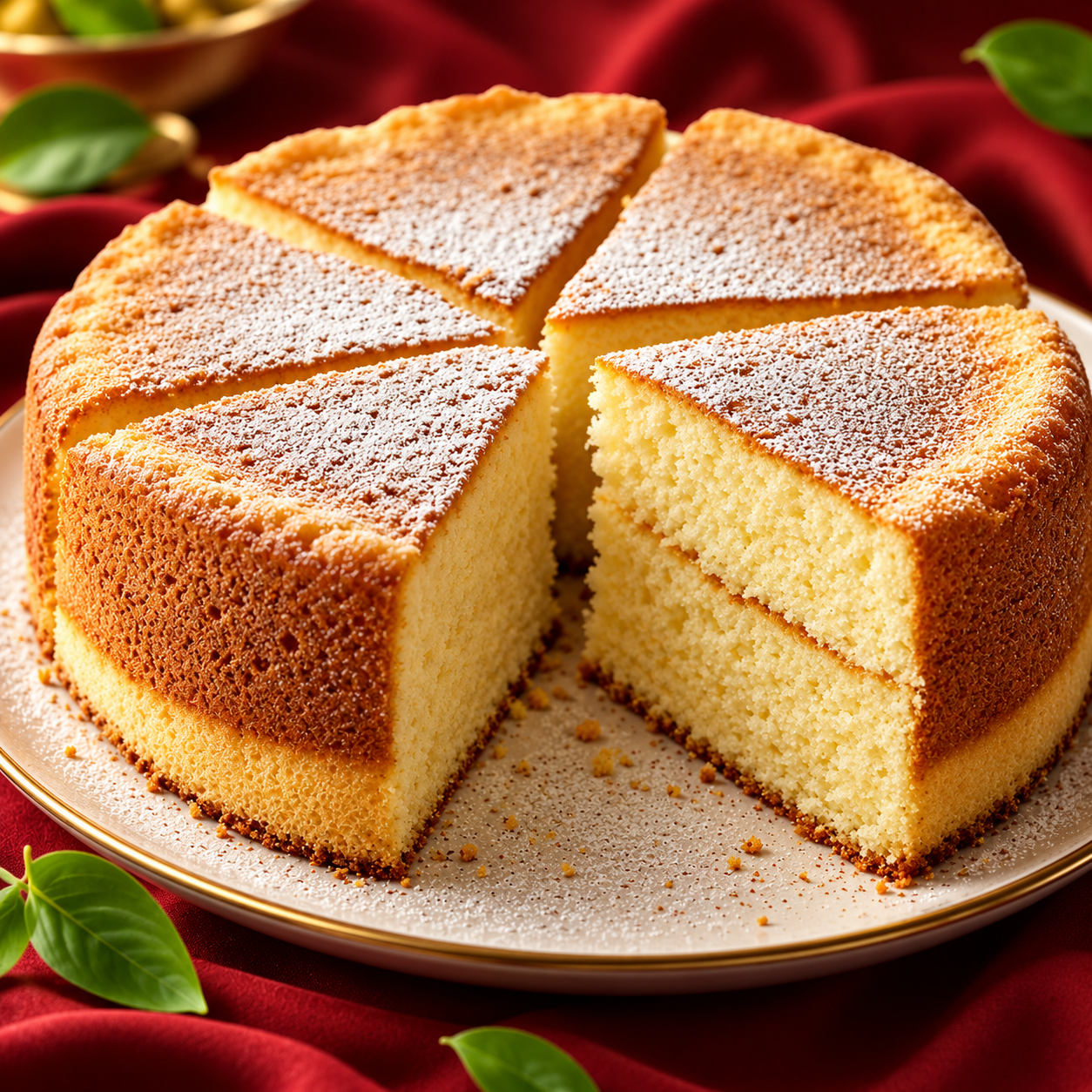
Most sponge cake mistakes happen in just a few moments: when you whip the eggs, when you fold in the flour, and when you open the oven. Because a sponge gets almost all its height from air, any lost air shows up as a cake that sinks, shrinks or turns dense.
This guide explains each mistake and how to fix it. After that, you will find a tested sponge cake recipe that rises tall and stays light.
The Most Common Sponge Cake Mistakes
- Under-whipped eggs that hold too little air.
- Heavy folding that knocks the air out.
- Opening the oven door too early.
- Underbaking, so the cake sinks as it cools.
Sponge Cake Mistakes and How to Fix Them
Under-whipped eggs
Cause: This usually happens because the eggs were cold or whipped for too short a time.
Fix: Use room-temperature eggs and whip them with the sugar for 8–10 minutes, until they reach the ribbon stage. In other words, the batter should fall from the whisk in a thick ribbon that stays on the surface for a few seconds.
Heavy or fast folding
Cause: Stirring the flour in breaks the air bubbles, and as a result the cake turns flat and dense.
Fix: Sift the flour over the eggs in three parts. Then fold with a large spatula, cutting down the middle and turning the bowl, just until no flour remains.
Opening the oven too early
Cause: Cold air hits the cake before its structure sets, so it collapses in the middle.
Fix: Keep the door closed for at least the first 20 minutes. Also, use the oven light to check the cake instead.
Underbaking
Cause: A pale, soft center is still wet, so it sinks as the steam escapes.
Fix: Bake until the top is golden and springs back when pressed. In addition, a skewer in the center should come out clean.
Cake shrinking from the sides
Cause: You greased the sides of the pan, so the batter had nothing to climb.
Fix: Line only the base with paper and leave the sides ungreased. Then, after baking, cool the cake upside down on a rack for 10 minutes.
Tested Sponge Cake Recipe
Ingredients
- 4 eggs, at room temperature
- 120 g (⅔ cup) sugar
- 1 teaspoon vanilla extract
- 120 g (1 cup) cake flour or all-purpose flour
- Pinch of salt
- 30 g (2 tablespoons) butter, melted and cooled
How to make the sponge cake
- Prepare. First, heat the oven to 175°C (350°F). Line the base of a 20 cm (8-inch) round pan with baking paper.
- Whip. Next, whip the eggs, sugar and vanilla on high speed for 8–10 minutes, until pale, thick and at the ribbon stage.
- Fold in the flour. Then sift the flour and salt over the eggs in three parts, folding gently after each part.
- Add the butter. After that, mix the melted butter with a spoonful of batter, and fold it back in.
- Bake. Pour the batter into the pan and bake for 25–30 minutes, until golden and springy.
- Cool. Finally, turn the pan upside down on a rack for 10 minutes, then release the cake.
Tips to Avoid Sponge Cake Mistakes
- Weigh the flour; otherwise, extra flour makes the cake dry.
- Bake the batter right away, because the foam starts to lose air as it waits.
- Tap the pan once on the counter to remove large air pockets.
Storage Tips
Wrap the cooled sponge and keep it at room temperature for 2 days. In addition, sponge layers freeze very well; see how to freeze cakes without losing moisture.
A Bit of History
Sponge cakes made with whipped eggs date back to European kitchens of the 1600s, long before baking powder existed. Since then, they have become the base for layer cakes, rolls and trifles. You can read more about sponge cake on Wikipedia.
Sponge Cake Mistakes FAQ
Can I add baking powder to a sponge cake?
Yes, ½ teaspoon gives extra security. However, well-whipped eggs are enough.
Why is my sponge cake rubbery?
You overmixed after adding the flour, so the gluten became strong.
Why did my cake dome and crack?
The oven was too hot. Therefore, check it with a thermometer and lower the heat by 10 degrees.
For more baking fixes, read our guides to flat choux pastry and why soufflés fall.
Looking for more ideas? If you found this guide to sponge cake mistakes useful, our digital cookbook also includes 31 Eastern and Western dessert recipes with exact measurements and step-by-step instructions.