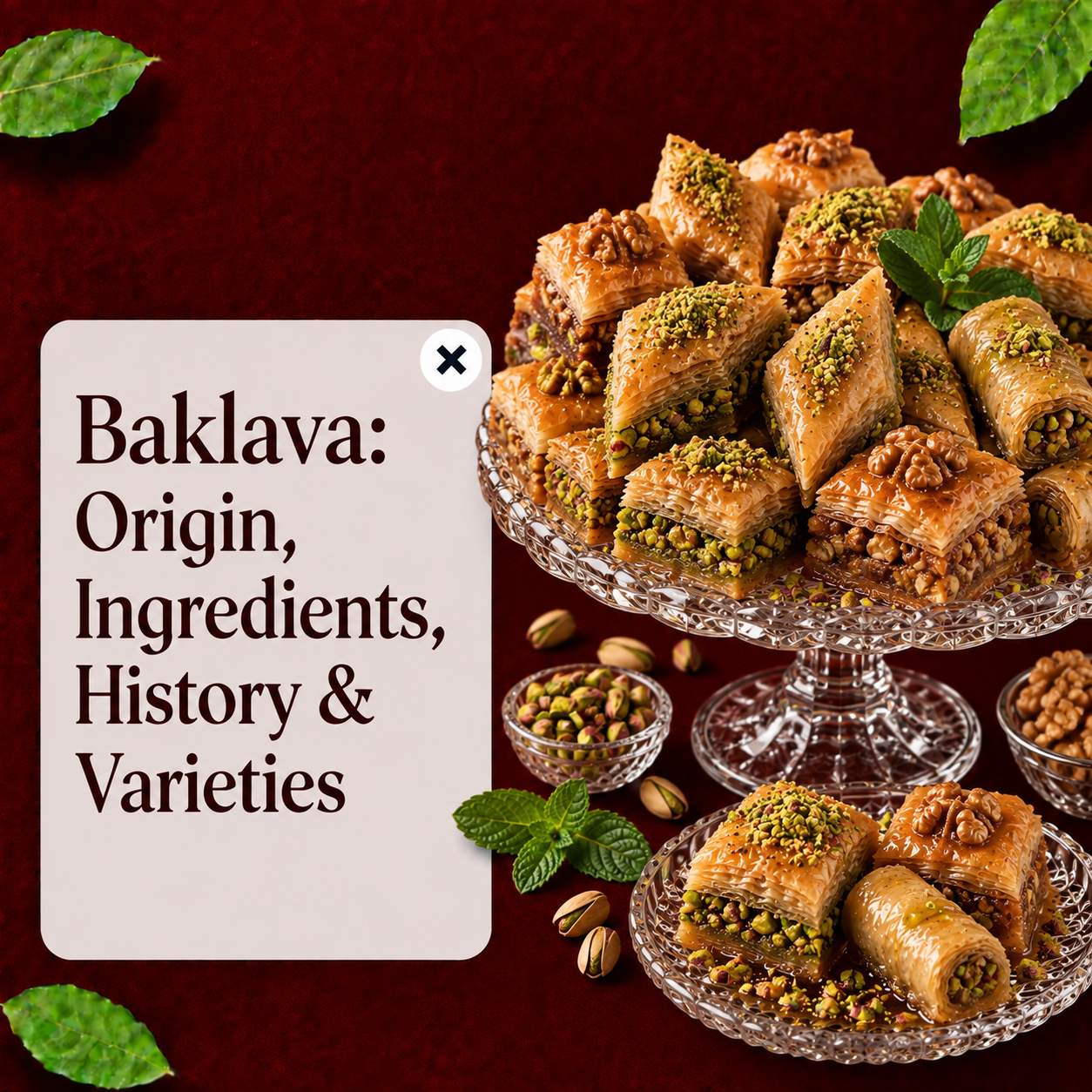
Baklava dessert is one of the most famous layered sweets in the Middle East and Mediterranean region. It combines thin pastry, butter or ghee, rich nuts, and sweet syrup.
Its crisp golden layers and nut-filled center give baklava a distinctive texture. Meanwhile, the syrup adds sweetness and moisture without removing the crunch of the pastry.
Today, baklava is strongly associated with Turkish, Middle Eastern, Greek, and Balkan cuisines. It is also enjoyed around the world in bakeries, restaurants, cafés, and homes.
Although recipes vary by region, the basic idea remains similar: thin pastry layers, nuts, fat, and syrup.
What Is Baklava Dessert?
Baklava is a layered pastry dessert made with very thin sheets of dough.
Butter or clarified butter is spread between the pastry sheets. Chopped nuts are then added between selected layers.
After baking, the pastry becomes golden and crisp. Sweet syrup is poured over it to create the familiar balance between crunchy pastry and soft nut filling.
Traditional baklava may contain:
- Pistachios
- Walnuts
- Almonds
- Hazelnuts
The choice of nuts often depends on local traditions.
The Origin of Baklava
The exact origin of Baklava dessert is difficult to trace to one country.
Layered pastries existed in several cultures across the Middle East, Central Asia, Anatolia, and the Mediterranean. Therefore, baklava likely developed through centuries of culinary exchange.
However, the form of baklava recognized today became especially refined during the Ottoman Empire.
Ottoman palace kitchens in Istanbul developed highly skilled methods for rolling extremely thin pastry sheets. Bakers also created elaborate combinations of nuts, butter, and syrup.
As the Ottoman Empire expanded, baklava became familiar across a large geographical area.
Consequently, Turkish, Arab, Greek, Armenian, and Balkan traditions developed their own versions.
Baklava During the Ottoman Empire
The Ottoman period played an important role in the development of baklava.
Pastry makers refined the technique of preparing very thin sheets of dough. At the same time, palace kitchens transformed baklava into an elegant dessert for important occasions.
The sweet eventually became associated with celebrations and formal hospitality.
Because Ottoman territories covered much of Southeast Europe, Anatolia, and the Middle East, similar forms of baklava appeared across many regions.
Each community later adapted the dessert to local tastes.
Why Is Baklava So Special?
The appeal of Baklava dessert comes from the contrast between several textures.
First, the pastry is thin and crisp.
Next, nuts create a rich and slightly crunchy filling.
Butter or ghee adds flavor and helps separate the layers during baking.
Finally, syrup provides sweetness and moisture.
As a result, a good piece of baklava remains crisp while also tasting rich and tender inside.
Phyllo Dough in Baklava
Modern baklava usually uses extremely thin pastry known as phyllo dough.
The word phyllo comes from a Greek word meaning “leaf.” This name reflects the paper-thin appearance of the pastry sheets.
Several sheets are stacked together to create delicate layers.
Butter or clarified butter is brushed between them. This prevents the sheets from sticking together during baking.
It also helps create the light, flaky texture associated with traditional baklava.
Before commercial phyllo became widely available, making thin pastry required considerable skill.
Pastry makers had to roll each piece until it became extremely thin.
Nuts Used in Baklava
Nuts are one of the most important ingredients in Baklava dessert.
Common varieties include:
- Pistachios
- Walnuts
- Almonds
- Hazelnuts
Different countries and cities often have their own preferences.
For example, pistachios are especially famous in southeastern Turkey.
Walnuts are common in several Greek and Balkan versions.
Meanwhile, many Levantine bakeries offer both pistachio and walnut baklava.
The type of nut affects the flavor, color, texture, and appearance of the dessert.
Pistachio Baklava
Pistachio baklava is one of the best-known varieties.
Finely chopped or ground pistachios are placed between layers of pastry. They may also be sprinkled over the top before serving.
Their bright green color creates an attractive contrast with the golden pastry.
Pistachios also have a rich flavor that pairs well with butter and sugar syrup.
For this reason, pistachio baklava is often considered one of the most luxurious varieties.
Gaziantep Baklava
The Turkish city of Gaziantep is particularly famous for pistachio baklava.
The region is well known for its pistachios, which are widely used in local sweets.
Gaziantep-style baklava usually emphasizes very thin pastry, rich pistachio filling, butter, and carefully balanced syrup.
The combination produces a crisp dessert with a strong nutty flavor.
Because of this tradition, Gaziantep has become internationally associated with premium baklava.
Walnut Baklava
Walnut baklava is another traditional and popular variety.
Walnuts create a deeper and slightly earthy flavor compared with pistachios.
They may be chopped finely or left in slightly larger pieces.
Walnut baklava is common in several countries across the eastern Mediterranean and Balkans.
Some versions also include cinnamon or other aromatic spices.
Butter and Ghee in Baklava
Butter plays an essential role in Baklava dessert.
It separates the pastry layers while they bake. In addition, it gives the pastry a rich flavor and golden appearance.
Some traditions use regular butter.
Others prefer clarified butter or ghee because it contains less moisture.
The type of fat can noticeably change the final flavor.
Since baklava uses relatively few ingredients, the quality of each ingredient is especially important.
Sugar Syrup in Baklava
Once baklava finishes baking, it is usually covered with sweet syrup.
Traditional sugar syrup is generally made from:
- Sugar
- Water
- Lemon juice
Some regional versions also include rose water or orange blossom water.
The syrup slowly enters the spaces between the pastry layers.
However, properly prepared baklava should still remain crisp.
Therefore, the balance between pastry and syrup is important.
Too much syrup can make the dessert excessively soft. Too little may leave it dry.
Honey and Baklava
Some baklava recipes use honey.
Honey is especially familiar in certain Mediterranean versions of the dessert.
It provides a deeper flavor than plain sugar syrup.
However, honey is not used in every traditional version.
Many Turkish and Levantine types rely mainly on sugar syrup instead.
Therefore, the sweetness and aroma of baklava can vary significantly between regions.
Baklava in Turkish Cuisine
Baklava has an important place in Turkish cuisine.
Traditional Turkish baklava is famous for extremely thin pastry layers and generous fillings.
Pistachios are especially popular, although walnut varieties are also common.
The dessert may be cut into:
- Squares
- Diamonds
- Rectangles
- Triangles
It is often served during holidays, celebrations, family visits, and other special occasions.
Tea or Turkish coffee is commonly served alongside it.
Baklava in the Levant
Baklava is also a major part of traditional sweets in the Levant.
It is enjoyed in countries such as:
- Syria
- Lebanon
- Palestine
- Jordan
Levantine baklava often contains pistachios, walnuts, or other nuts.
Some versions include floral syrup flavored with rose water or orange blossom water.
Baklava also appears in large assortments of traditional Arabic sweets.
These assortments are commonly served during Ramadan, Eid, weddings, and family celebrations.
Baklava in Greek Cuisine
Baklava also has a long presence in Greek cuisine.
Many Greek versions use walnuts and honey.
Cinnamon may also appear in the nut filling.
These ingredients create a different flavor profile from many Turkish or Levantine varieties.
Nevertheless, the main structure remains familiar: thin pastry, nuts, butter, and sweet syrup.
This similarity reflects centuries of cultural interaction across the eastern Mediterranean.
Baklava in the Balkans
Baklava spread widely throughout the Balkans during centuries of Ottoman influence.
Today, regional versions can be found in several Balkan cuisines.
Recipes may differ in:
- Nut selection
- Syrup sweetness
- Pastry thickness
- Cutting style
- Added spices
Walnuts are especially common in many Balkan varieties.
Despite local differences, the basic layered structure remains recognizable.
Different Shapes of Baklava
Baklava dessert is not limited to the familiar diamond shape.
Pastry makers prepare it in several forms.
Common shapes include:
- Squares
- Diamonds
- Triangles
- Rolls
- Fingers
Some versions have many thin pastry layers.
Others place a thick nut filling between fewer layers.
Rolled varieties may contain nuts inside a long cylinder of pastry.
These different shapes allow bakeries to create visually distinctive assortments.
Rolled Baklava
Rolled baklava is made by wrapping thin pastry around a nut filling.
The roll is then cut into smaller portions before or after baking.
This style creates a slightly different ratio between pastry and nuts.
Some rolls contain pistachios, while others use walnuts.
Because more filling may remain visible, rolled baklava can also create an attractive presentation.
Baklava During Ramadan and Eid
Baklava is commonly served during important religious and family occasions.
During Ramadan, it may be served after iftar alongside coffee or tea.
It is also popular during Eid celebrations.
Families may purchase large trays containing several varieties of baklava and other traditional sweets.
Because baklava can be prepared and served in small pieces, it is practical for sharing with guests.
Baklava at Weddings and Celebrations
Baklava is not limited to religious holidays.
It is also served at:
- Weddings
- Engagements
- Family gatherings
- Formal visits
- Special celebrations
Its attractive appearance makes it suitable for elegant dessert tables.
Furthermore, nuts such as pistachios give premium varieties a luxurious appearance.
For these reasons, baklava has remained closely linked with hospitality.
Baklava and Coffee
Baklava is frequently served with coffee.
The slightly bitter flavor of unsweetened coffee balances the sweetness of the syrup.
Turkish coffee is a traditional pairing in Turkey and parts of the Middle East.
Arabic coffee may also be served with baklava in Arab countries.
Tea is another popular choice.
These drinks help balance the rich combination of pastry, butter, nuts, and syrup.
Baklava vs. Kunafa
Baklava and kunafa are both famous Middle Eastern desserts. However, they are very different.
Baklava uses multiple thin pastry layers filled mainly with nuts.
Kunafa uses a different type of pastry. It may be fine and thread-like or slightly coarser.
In addition, kunafa often contains cheese or cream.
Baklava is generally crisp and layered throughout.
Kunafa, by comparison, usually has a softer filling surrounded by toasted pastry.
Both desserts are commonly finished with sugar syrup.
Baklava vs. Other Layered Pastries
Baklava is sometimes compared with other layered pastries because of its use of phyllo dough.
However, its combination of nuts and syrup gives it a distinct identity.
Unlike savory phyllo dishes, baklava is intensely sweet and usually served in small portions.
It also contains many pastry layers rather than one simple crust.
Therefore, its texture is both delicate and rich.
Modern Baklava Varieties
Traditional Baklava dessert remains extremely popular. However, modern pastry shops continue to create new versions.
Examples include:
- Chocolate baklava
- Chocolate and pistachio baklava
- Coffee-flavored baklava
- Hazelnut baklava
- Extra-pistachio baklava
- Cream-filled variations
Some bakeries also combine baklava with modern desserts.
Even so, the traditional combination of pastry, nuts, butter, and syrup remains the foundation.
Baklava Around the World
Baklava eventually spread far beyond its traditional regions.
Migration helped introduce it to Europe, North America, Australia, and other parts of the world.
Today, customers can find baklava in:
- Middle Eastern bakeries
- Turkish restaurants
- Greek pastry shops
- Mediterranean cafés
- International supermarkets
Its popularity has also grown through tourism and social media.
As a result, baklava has become one of the world’s most recognizable Middle Eastern and Mediterranean sweets.
Why Has Baklava Remained Popular?
Several qualities explain the lasting popularity of Baklava dessert.
First, its crisp pastry creates an appealing texture.
Second, nuts provide richness and flavor.
In addition, syrup gives the dessert sweetness and aroma.
Baklava can also be made in many shapes and with different nuts.
Therefore, each region can create its own style without changing the basic identity of the dessert.
Baklava as a Culinary Tradition
Baklava is more than a sweet pastry.
It represents centuries of culinary exchange between communities across Anatolia, the Middle East, the Balkans, and the Mediterranean.
Different regions now have their own traditions.
Some emphasize pistachios. Others prefer walnuts or almonds.
Likewise, some use floral syrup, while others favor honey or simple sugar syrup.
These differences have helped baklava develop many regional identities while remaining instantly recognizable.
Baklava: A Famous Layered Dessert
Baklava dessert combines thin pastry, rich nuts, butter or ghee, and sweet syrup to create one of the world’s best-known layered sweets.
Its exact historical beginning remains difficult to identify. However, its development during the Ottoman period played an important role in shaping the baklava known today.
From pistachio baklava in Turkey to walnut varieties in Greece and the Balkans, each region has created its own interpretation.
Meanwhile, Levantine baklava continues to hold an important place at Ramadan gatherings, holidays, weddings, and family celebrations.
With its golden crispy layers, rich nut filling, and fragrant syrup, baklava has remained popular for generations.
Today, it represents both a traditional dessert and a shared culinary heritage that connects several cultures across the Middle East and Mediterranean region.
Strawberry Ice Cream: A Classic Flavor Combining Refreshment and Natural Sweetness