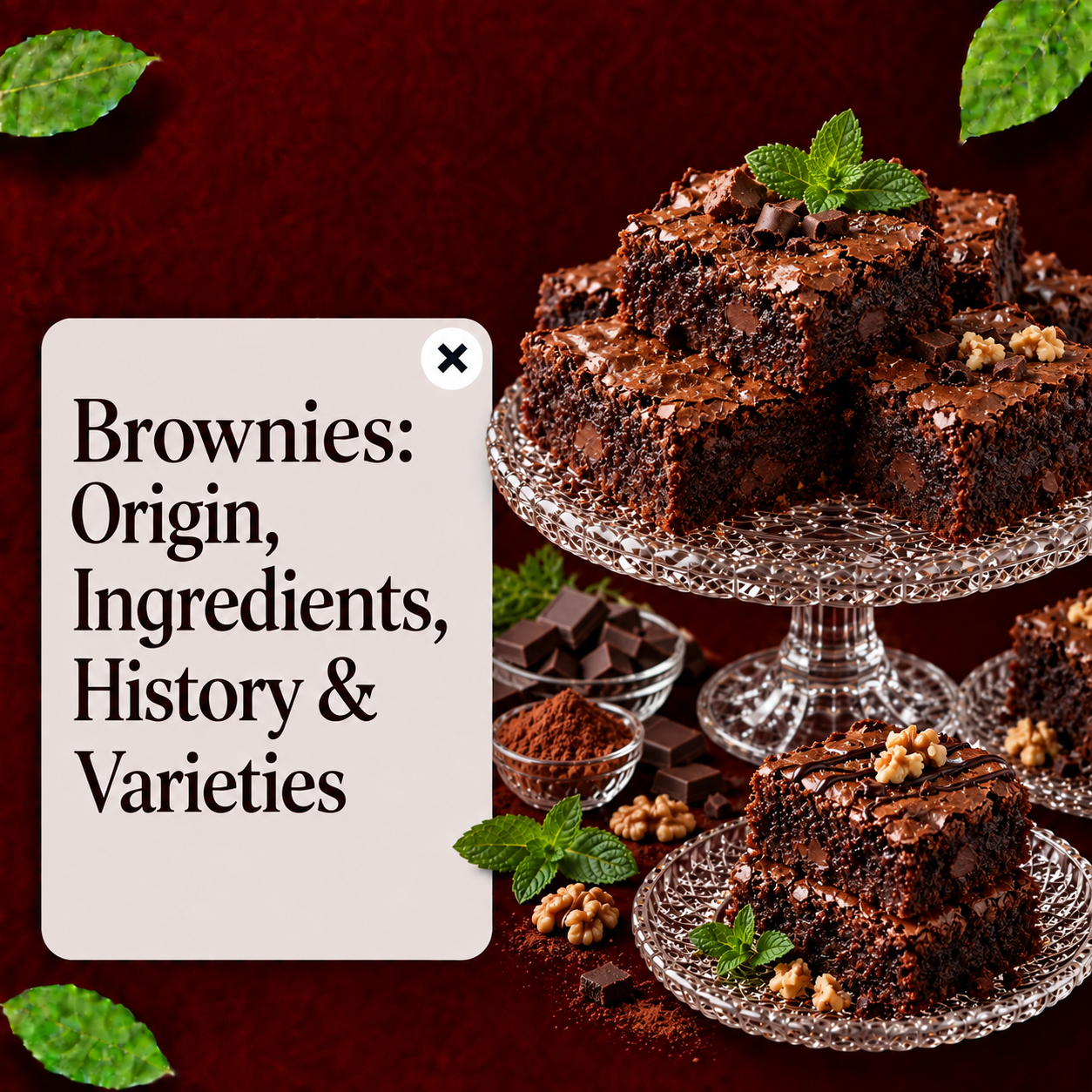
Brownies are among the most famous American desserts and have become widely popular around the world. They are known for their rich chocolate flavor and distinctive texture, which falls somewhere between a cake and a dense confection.
Thanks to their simple ingredients and easy preparation, brownies spread from American kitchens to cafés, bakeries, pastry shops, and homes across the globe, becoming one of the most beloved desserts among chocolate lovers.
The Origin of Brownies .
Brownies originated in the United States in the late nineteenth century, although several stories exist about how they first appeared.
One of the best-known accounts connects an early version of the brownie to Chicago during the 1890s, when a small dessert was requested that could be eaten easily and packed conveniently into lunch boxes.
By the beginning of the twentieth century, brownie recipes began appearing more frequently in American cookbooks and gradually developed into the dessert we recognize today.
As with many historic foods, several competing stories exist about the earliest true brownie recipe, making it difficult to identify one person as its definite inventor.
Why Are They Called Brownies?
The name brownie is most likely connected to the dessert’s characteristic brown color, which comes from chocolate or cocoa powder.
The English word “brown” refers to the color traditionally associated with the dessert.
As brownies became more popular, the name came to describe the dense chocolate squares or rectangles that are usually baked in a tray and cut after cooling.
What Makes Brownies Different?
Brownies differ from traditional cake mainly in their texture.
Cake is generally lighter and more airy because it usually contains more flour and leavening ingredients. Brownies, on the other hand, tend to be denser, moister, and richer in chocolate.
The proportion of fat and chocolate to flour is usually higher in brownies, which helps create their characteristic texture.
An ideal brownie may have a soft and moist center with a thin, slightly firm layer on the surface.
The Basic Ingredients of Brownies .
Traditional brownies are made with a relatively simple group of ingredients, including:
Chocolate or cocoa powder, butter, sugar, eggs, and flour.
Vanilla is often added to enhance the chocolate flavor, while a small amount of salt can help balance the sweetness.
Depending on the recipe, melted chocolate, cocoa powder, or a combination of both may be used to create a deeper and richer chocolate flavor.
Types of Brownies .
Not all brownies are the same. They can generally be divided into several categories based on their texture.
Fudgy Brownies
Fudgy brownies are among the most popular varieties.
They usually contain a higher proportion of butter and chocolate compared with flour, giving them a moist, dense center similar to the texture of chocolate fudge.
Cakey Brownies .
Cakey brownies have a lighter and more risen texture.
They usually contain relatively more flour or leavening ingredients, making them closer to chocolate cake while still remaining denser than an ordinary cake.
Chewy Brownies .
Another popular variety is the chewy brownie, which combines moisture with a slightly firm and elastic texture.
Many brownie lovers prefer this style because it offers a balance between the dense fudgy version and the lighter cakey version.
Chocolate: The Key to the Flavor .
The quality of the chocolate or cocoa plays an important role in determining the final flavor of brownies.
The richer the cocoa flavor, the deeper and more intense the brownies will taste.
Dark chocolate can be used to create a stronger, less sweet flavor, while milk chocolate provides a softer and sweeter taste.
Adding chocolate chunks or chocolate chips to the batter has also become popular, creating small pockets of melted chocolate inside each piece.
Nuts and Brownies .
One of the most traditional additions to brownies is walnuts, which provide a crunchy texture that contrasts with the softness of the chocolate base.
Pecans, hazelnuts, and almonds can also be used.
Opinions differ when it comes to nuts in brownies. Some people consider walnuts an essential part of the classic dessert, while others prefer their brownies made with chocolate alone.
Brownies vs. Chocolate Cake .
Although both desserts rely heavily on chocolate or cocoa, there are clear differences between them.
Chocolate cake usually has a light and airy texture and contains leavening agents that help it rise during baking.
Brownies, in contrast, are shorter and denser and generally contain less flour and a higher proportion of fat and chocolate.
This is also why brownies can easily be eaten by hand after being cut into squares, while chocolate cake is more commonly served in slices.
The Thin Shiny Crust on Brownies .
One of the most recognizable features of some brownies is the thin, shiny, slightly crackled layer that forms on top.
This crust develops through the interaction of sugar, eggs, and fat during mixing and baking.
Many brownie lovers consider it an appealing feature because it creates a distinctive appearance while the interior remains soft and rich.
How Brownies Are Served .
Brownies can be enjoyed in many different ways.
They are delicious on their own, whether served warm or at room temperature. They are also commonly paired with vanilla ice cream, creating a contrast between the warm brownie and the cold ice cream.
Chocolate sauce, caramel sauce, fresh fruit, or powdered sugar may also be added.
Brownies can even be used as a base for other desserts or incorporated into ice cream sundaes and chilled dessert creations.
Brownies Around the World .
After beginning as an American dessert, brownies gradually spread to countries around the world.
Today, they can be found in cafés, bakeries, pastry shops, and homes almost everywhere. They have also become one of the most popular homemade desserts because they are relatively easy to prepare and usually do not require elaborate decoration.
As their popularity grew, hundreds of variations appeared, including dark chocolate brownies, walnut brownies, caramel brownies, peanut butter brownies, and many others.
Brownies and the Love of Chocolate .
A major reason for the popularity of brownies is their ability to deliver an intense chocolate experience in a small piece.
They combine rich chocolate flavor, a soft and dense texture, and a distinctive thin top crust, while remaining easy to customize with nuts, chocolate pieces, sauces, and other additions.
More than a century after their appearance in the United States, brownies remain one of the most recognizable desserts in the world.
Thanks to their simple ingredients and endless variations, they have evolved from a traditional American sweet into a global dessert enjoyed in homes, cafés, and bakeries across many different cultures.
Date Cake: A Rich Dessert Combining Traditional Flavor with a Soft Texture