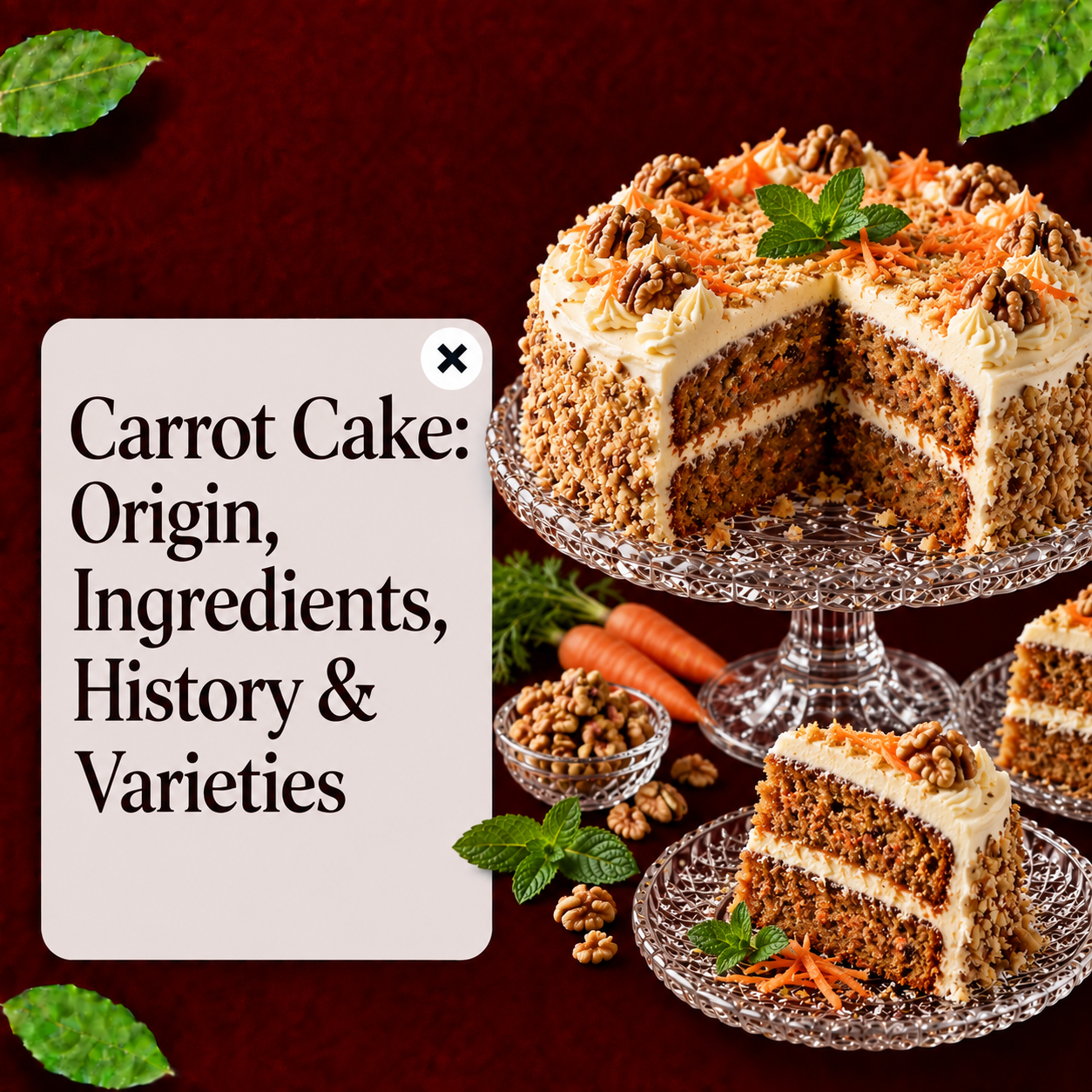
Carrot cake is one of the most popular types of cake around the world. It is known for its soft, moist texture and warm flavor, which combines grated carrots with aromatic spices. It is also often topped with a rich layer of cream cheese frosting.
Although using carrots in a dessert may seem unusual, their natural sweetness and moisture make them an ideal ingredient for cakes. These qualities helped carrot cake become popular in Europe and the United States before spreading to many other parts of the world.
The Origin of Carrot Cake
During the Middle Ages in Europe, sugar was expensive and difficult for many people to obtain. As a result, naturally sweet vegetables such as carrots were sometimes used in puddings and other desserts.
Over time, these preparations gradually developed into recipes more similar to the carrot cake we know today.
Carrot cake became increasingly popular during the nineteenth and twentieth centuries, especially in Britain and the United States.
Why Are Carrots Used in Cake?
Carrots have natural sweetness and contain a good amount of moisture, allowing them to perform several important roles in cake.
When carrots are grated and added to the batter, they help retain moisture during baking, which keeps the cake soft and prevents it from drying out too quickly.
They also add a mild sweetness and distinctive color without giving the finished cake an overpowering vegetable flavor.
For this reason, carrot cake tastes more like a rich, warmly spiced cake than a vegetable-based dessert.
The Basic Ingredients of Carrot Cake
Most carrot cake recipes are made with a simple group of ingredients, including:
Grated carrots, flour, sugar, eggs, oil or butter, and cinnamon.
Baking powder or baking soda is usually added to help the cake rise.
Some recipes also include vanilla, nutmeg, ginger, or cloves to create a warmer and more complex flavor.
Why Is Oil Often Used?
Many carrot cake recipes use oil instead of butter.
Oil helps produce a particularly moist texture and keeps the cake soft even after it has cooled.
This works especially well with grated carrots, which also contain natural moisture.
However, some recipes use butter for a richer flavor, while others combine both oil and butter.
Spices and the Flavor of Carrot Cake
Spices are an important part of the character of carrot cake.
Cinnamon is the most common and gives the cake its familiar warm aroma and distinctive flavor.
Nutmeg, ginger, and cloves may also be added in small amounts.
Nuts and Carrot Cake
Nuts are frequently added to carrot cake, especially walnuts or pecans.
They provide a gentle crunch that contrasts with the soft texture of the cake.
Some recipes also include raisins, pineapple, or coconut, creating an even richer texture and flavor.
These additions vary according to country, recipe, and personal preference.
Cream Cheese Frosting
Cream cheese frosting has become one of the ingredients most strongly associated with modern carrot cake.
It is usually made from cream cheese, powdered sugar, and butter or cream.
The frosting adds a rich and creamy flavor with a slight tanginess that helps balance the sweetness of the cake.
Its bright white appearance also creates an attractive contrast with the orange or light brown color of the cake.
Single-Layer and Layered Carrot Cakes
Carrot cake can be served in many different forms.
It may be baked as a simple single-layer cake and served without frosting, or prepared as a two- or three-layer cake with cream cheese frosting between each layer.
It can also be made into cupcakes or smaller individual portions suitable for cafés and special occasions.
Layered carrot cakes have become particularly popular for celebrations and birthdays.
Is Carrot Cake Healthy?
Despite containing carrots, carrot cake is still a dessert.
It usually contains sugar, flour, and fat, and may also be topped with a generous amount of cream cheese frosting.
Therefore, the presence of carrots does not automatically make the cake low in sugar or calories.
However, carrots do contribute natural moisture and flavor, and recipes can be adjusted by reducing the amount of added sugar or frosting when desired.
Carrot Cake vs. Traditional Cake
Carrot cake differs from many traditional cakes because grated carrots are incorporated directly into the batter.
It is usually more moist and slightly denser than a light sponge cake.
Its flavor also depends heavily on spices and nuts, while cakes such as vanilla cake usually have a simpler flavor profile.
This gives carrot cake a distinctive character that combines moisture, warm spices, and moderate sweetness.
Carrot Cake in Britain and America
Carrot cake is especially popular in Britain and the United States.
In Britain, desserts made with carrots became associated with periods when sugar was less readily available, and carrot cake later became a familiar item in bakeries and cafés.
In the United States, its popularity increased significantly during the twentieth century, and carrot cake topped with cream cheese frosting became one of its most recognizable forms.
Carrot Cake in Cafés and Special Occasions
Today, carrot cake is a staple in many cafés, bakeries, and pastry shops.
It is commonly served with coffee or tea and is also popular at birthdays, family gatherings, and celebrations.
Its warm spices make it especially suitable for autumn and winter, although it is enjoyed throughout the year.
Carrot Cake Around the World
As modern bakeries and American and European baking styles spread internationally, carrot cake became popular in many parts of the world.
Different versions now include local ingredients such as pistachios, dates, and various types of nuts.
Some versions are served without cream cheese frosting, while others use lighter toppings or are simply dusted with powdered sugar.
Even with these variations, the combination of carrots, cinnamon, nuts, and cream cheese frosting remains the image most strongly associated with modern carrot cake.
A Distinctive Dessert with a Unique Character
The appeal of carrot cake lies in the way an ingredient not usually associated with desserts can be transformed into something rich, soft, and flavorful.
Carrots provide moisture and gentle sweetness, spices give the cake its warm aroma, nuts add crunch, and cream cheese frosting balances the overall flavor.
Thanks to this combination, carrot cake has become one of the most popular cakes in the world, evolving from traditional homemade recipes into a favorite in modern bakeries and cafés.
Carrot cake remains a wonderful example of how a simple ingredient such as the carrot can be transformed into an elegant, flavorful dessert loved across many different cultures.
Chocolate Lazy Cake: A Simple No-Bake Dessert Combining Biscuits and Chocolate
Chocolate Lazy Cake is one of the most popular easy no-bake desserts. It does not require baking in the oven and is made mainly from biscuits and a chocolate mixture before being chilled in the refrigerator until firm.
Its simplicity and short ingredient list have helped make it popular in many countries, especially as a quick homemade dessert that can be prepared without special equipment or complicated techniques.
Why Is It Called Lazy Cake?
The name Lazy Cake comes from the fact that it is much easier to prepare than a traditional cake.
It usually requires no long mixing process, complicated batter, or oven. Instead, biscuits are broken into pieces, combined with a chocolate mixture, shaped, and chilled.
For this reason, it has become especially popular among beginners and anyone looking for a quick dessert with only a few preparation steps.
The Origin of Lazy Cake
It is difficult to identify one country as the original birthplace of Lazy Cake because desserts made by combining biscuits with chocolate and chilling them have appeared in different forms across many cultures.
Very similar desserts can be found in Europe and the Middle East, including Chocolate Biscuit Cake, as well as other versions known by different names depending on the country.
Over time, the name Lazy Cake became widely used in many Arab countries to describe the chilled version made with biscuits and chocolate sauce.
The Basic Ingredients
Lazy Cake is usually made from plain biscuits, chocolate or cocoa powder, butter, sugar, and milk.
Tea biscuits are commonly used because they absorb some of the chocolate mixture while still retaining part of their texture, creating the dessert’s characteristic appearance when sliced.
The chocolate mixture binds the biscuit pieces together and gives the cake its rich flavor and firm texture after chilling.
Biscuits Are the Key to the Texture
Biscuits are the ingredient that gives Lazy Cake its distinctive interior pattern.
They are usually broken into medium-sized pieces rather than crushed into fine crumbs, allowing the biscuit pieces to remain clearly visible when the cake is sliced.
This creates an appealing contrast between the smooth chocolate mixture and the firmer pieces of biscuit.
The size of the pieces can vary according to preference. Larger pieces create a more noticeable biscuit pattern inside each slice.
Chocolate and Cocoa
Lazy Cake can be prepared with cocoa powder, melted chocolate, or a combination of both.
Cocoa powder provides a strong chocolate flavor, while melted chocolate usually gives the mixture a richer and smoother consistency.
Dark chocolate or milk chocolate may also be used depending on the preferred level of sweetness.
Why Does It Not Need Baking?
Lazy Cake does not usually contain raw cake batter that needs to be baked.
The biscuits are already baked, while the chocolate mixture is prepared separately and combined with them.
Chilling then plays an important role by allowing the butter and chocolate to firm up, making the dessert easy to cut into slices or cubes.
For this reason, Lazy Cake belongs to the category of no-bake desserts.
The Importance of Chilling
Chilling is one of the most important stages in preparing Lazy Cake.
After the mixture is placed in a mold or shaped into the desired form, it is refrigerated for several hours until completely firm.
The longer it has enough time to chill properly, the easier it becomes to slice neatly.
Chilling also allows the biscuits to absorb part of the chocolate mixture, helping the flavors blend together more evenly.
Nuts and Other Additions
Although the simplest version contains only biscuits and chocolate, many other ingredients can be added for extra flavor and texture.
Popular additions include:
Walnuts, hazelnuts, almonds, pistachios, coconut, raisins, and chocolate pieces.
Nuts provide a gentle crunch that complements the smooth chocolate texture.
Vanilla or coffee may also be added to create a deeper and more aromatic flavor.
Lazy Cake and Chocolate Biscuit Cake
Lazy Cake is very similar to what is known as Chocolate Biscuit Cake, and the two names are often used for desserts that are closely related.
However, recipes can vary from one country to another.
Some versions of Chocolate Biscuit Cake use large amounts of solid chocolate and cream, while many homemade Lazy Cake recipes rely on a simpler mixture of cocoa, butter, sugar, and milk.
The basic idea remains the same in both cases: pieces of biscuit held together by a rich chocolate mixture without the need for baking.
Lazy Cake vs. Traditional Cake
Lazy Cake is very different from traditional cake.
Ordinary cake is made from a batter that usually contains flour, eggs, and leavening agents, then baked in the oven to create a soft or spongy texture.
Lazy Cake, on the other hand, is based on ready-made biscuits and requires neither leavening ingredients nor baking.
Its texture is generally denser and firmer, with pieces of biscuit clearly visible in every slice.
How Lazy Cake Is Served
Lazy Cake is usually served cold after being removed from the refrigerator and cut into slices.
It can be decorated with melted chocolate, cocoa powder, coconut, or ground nuts.
It may also be served with strawberries, berries, or a scoop of vanilla ice cream.
Its simple appearance makes it suitable both as an everyday homemade dessert and as an attractive sweet for gatherings and special occasions.
Lazy Cake at Family Gatherings
Lazy Cake has become a popular homemade dessert because it can be prepared in advance and stored in the refrigerator.
This makes it a convenient choice for family gatherings, birthdays, and hospitality, especially when preparation time is limited.
It is also especially popular during summer because it is served cold and does not require the use of an oven.
Lazy Cake Around the World
Similar desserts exist in many countries under different names.
In some places, they are known as Chocolate Biscuit Cake, while various European versions combine chocolate, biscuits, and nuts in a chilled log or molded shape.
Social media and recipe websites have helped increase the popularity of the name Lazy Cake, making it one of the most widely shared no-bake dessert recipes today.
A Simple Dessert with a Rich Flavor
The appeal of Lazy Cake lies in its ability to deliver a rich chocolate flavor using only a few ingredients and a very simple preparation method.
It combines smooth chocolate, firm biscuit pieces, and a rich chilled texture, while allowing nuts and other flavors to be added easily.
Because it requires no baking and can be prepared in advance, Chocolate Lazy Cake has become one of the most popular quick homemade desserts, enjoyed by both adults and children and suitable for many different occasions.